
I would like to introduce you to one of the opinions of yoga master AV Sidersky:
And what is this
“Indian gymnastics” for anyway?
First of all, injuries during yoga practice arise from the most important mistake that almost everyone who starts practicing yoga makes, as I accidentally discovered recently.
And it is precisely because of this mistake, as I will now call it, that many people who start training earn injuries. A person comes to a fitness center and says: yoga is stretching, right? Here. And here lies the most important mistake. Yoga and stretching have nothing to do with each other. The practice of hatha yoga and good stretching are things, if not mutually exclusive, then at least good stretching makes it very difficult to get from yoga the effect that it can give. I’ll explain now.
If we try to find the very first definition of yoga, then somewhere in the Vedas we will come across it. The Vedas are very old books, nailed down by the dust of time, now these texts are not applicable in the current situation, they are hopelessly outdated, but nevertheless, some basic information that is there goes through centuries and millennia, because it concerns the structure of the universe. Rather, some aspects of the universe – they don’t change very much, the picture of the use of information in society is changing, and amendments are being made. Then this very first definition of yoga pops up in the Upanishads. There is a certain Yama, the god of death, who tells a person who longs to join what yoga is. He says that yoga is the ability to control all your emotions. At that time, some thousands of years ago, self-control was limited to the possession of emotions, because a person was more driven by an instinctive mind, and uncontrolled emotions were the most serious stumbling block. And it didn’t come to finer control, it was necessary to first cope with their bestial, animal manifestations. At that time, no one had any idea about the meaning of the word yoga as one of the six orthodox systems of Indian philosophy — deep contemplation, unity with the supreme, etc. Because the meaning of the word appeared already as a result of the practical development of the system, as a result of the development of methods after Christ, after Patanjali, and then it was used in its first meaning. And the first meaning is a bridle, a harness, a curb, i.e. if translated into modern terminology, it is control. So, the first definition of yoga is that control is the ability to control all your emotions. Then, with the development of society and man, and the ability of man to realize what he is doing, this definition has undergone some change. And Patanjali, in the second century before the birth of Christ, already expanded it somewhat and said that yoga is the elimination of the vanity of the mind. That is, control is the elimination of the vanity of the mind or the cessation of the vanity of the mind. It was no longer just about controlling emotions, but also about the ability to use a mental apparatus, the ability to work with images, manage the sphere of generating images, ideas, intentions — this is a deeper thing.
But what turns out to be: a person sits down, folds his legs into a lotus, sits for 4, 5, 10 hours, controlling his mind, and his brain begins to rebuild the mode of operation. Indeed, if a person focuses on the lid of the skull, the process of creative thinking or the process of controlled movement of awareness is distributed throughout the cerebral cortex and a powerful stream of energy rushes there, because the brain requires it. Energy is collected along the spine from all possible sources, all that is in the body, and is drawn to the brain. This is called Kundalini awakening. But energy is not taken from nowhere, it must be provided by metabolic processes in the organs, and the organs of an ordinary person are accustomed to the usual normal flickering sluggish current process. When switching to a new operating mode occurs, this process requires an increase in energy consumption. These are the laws of physics, they are the same for all systems — we know that critical calculations of any system are always based on the maximum load level, i.e. maximum flows, maximum currents, voltage, maximum fluctuations. And this activation process, the Kundalini process, is the most powerful transitional process in the entire system. And if the organs can’t support it, they can’t, they don’t have the resources, what happens then — they start to weaken and collapse. And if there is a bacterium or virus or something else somewhere, it quickly bites into and completely destroys the body.
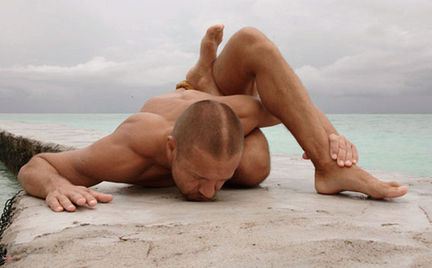
What happens? If we immediately start trying to control our mind, but our body is unable to support these attempts, then either we fail or we destroy ourselves. Ancient yogis faced this problem, they realized that in order to successfully practice raja yoga, i.e. direct control of consciousness, you need to have a prepared material resource, you need to do something with the body and with its ability to enhance metabolic processes, generate a certain amount of energy. To enable the body to adapt more easily to increased stress and increase the immune barrier so that viruses, bacteria, etc. do not gnaw the body under increased stress. They searched for a long time for a way to achieve this, and, in the end, they imperially adopted a gymnastic system based on stretching connective tissue. What is an asana? An asana is a body shape that we give in order to stretch the tendon–muscle harnesses, and the more powerful the harnesses, the more they are, the more effective the asana is in terms of increasing immunity and enhancing the adaptive abilities of the body. The yogis of antiquity and the Middle Ages came to this imperially, academician Bogomolets in the 20-30s clearly proved the interdependence of the state of connective tissue and human immunity in clinical experiments. The condition of connective tissue (tendons, connective tissue sacs containing muscles, joint pouches, intra-articular ligaments, connective tissue membranes of organs, etc.) directly determines the level of immunity and the level of adaptive abilities of the body. Asana is a way to stretch connective tissues so that they give us an increase in the body’s ability to withstand the overloads that arise when trying to integrate into the control modes of the brain. All. Everything is very simple. Just down to the primitive.
Now let’s look at an example — a well-stretched person starts practicing yoga. It stretches, but in order for the system to work, you need, first, extreme stretching – only then does the body begin to change – the tissue begins to change when the body realizes that it does not have enough abilities, it needs to develop. The question arises: who will get to this deep stretching mode easier and faster and with simpler forms — a person who is well stretched or a person who is not stretched? Of course, a person who is not stretched. He only needs to bend a little bit – and that’s it, everything is already working for him. This is a typical example when a poorly stretched person starts practicing yoga, he very quickly changes in the brain, consciousness, and the state of the body as a whole — he gets into the subject faster. And a well-stretched person stretches, bends, but he remains a well-stretched person, he remains the same emotional jerk he was before. I know a lot of them, especially men who are well-stretched, they are all cool, they do everything well. But these are not asanas, but just an empty gymnastic form, it does not work, because in order to make an asana, a well-stretched person has to be sophisticated and invent deeper and deeper things. What’s the problem? The problem is that when a person repeats asanas day after day and begins to control the brain, the body works out and becomes more stretched according to the feedback principle, then you have to find more complex forms. Complex asanas are invented precisely because at some stage the simple ones stop working. And the task of practicing asanas is to give the body a set of shapes that would run through all the tendon-muscle bundles with deep stretching, and in each asana you need to fix this picture. But if we just drag it out, we’ll end up just messing with this system. Reverse compensation is required. Just as we stretch the tendon-muscle bundles, we must also maximize the use of static isometric muscle tension. Why I always insist on doing lower handstands is because they belong to the category of the most strenuous exercises, and they compensate for stretching asanas. If you do stretching and do not do power asanas, the system becomes loose and after a while the hatha yoga asana as such stops working. It remains a purely gymnastic form. Both the pull statics and the voltage statics should be quite long. Naturally, additional dynamic processes are needed to push physiological fluids, so that lubricant circulates in the joints so that the spine does not jam. For this purpose, dynamic elements are used in the transitions between asanas. They must be mandatory. Let it be gymnastic-like elements or qigong-like. Qigong-like elements are preferable in terms of the distribution of energy density in the system.
This is how we enter the practice of asanas, which naturally has its own laws of form construction. If the asanas are done correctly, then in a minimum period of time we achieve the maximum effect in terms of boosting immunity and increasing the adaptive abilities of the body. If the asanas are done incorrectly, then there are, firstly— distortions, and secondly— injuries.
/Author of the article: A.V.Sidersky/