

“death is the erasure of everything that is not you”
- Eckhart Tolle
When high-level practitioners die, they can enter a state called “tukdam” in Buddhism and thus gain victory over death.
Tukdam (tib. holy mind) is a postmortem state in which an experienced tantric practitioner, who during his lifetime was engaged in meditations of the completion stage of anutarayoga tantra (higher yoga tantra), is able to recognize the subtlest consciousness of clear light, which becomes for him the object of meditation.
Despite the fact that the fact of death has been fixed, and the heartbeat and blood circulation have stopped, the body of such a practitioner remains fresh until the moment of the final exit of subtle consciousness from the body. This condition has no scientific basis yet.
In this meditative state, the body continues to retain heat, and its cells do not decompose. This is a sign that the practitioner entered meditation at the time of death and can now maintain this state of his own volition.
If at the time of death we recognize the nature of the mind, do not let unfamiliar images bring us out of our state of awareness, then we will know that we have died and we will recognize all the manifestations of death.
If control over the mind is lost, then it can no longer be subdued and uncontrolled rebirth (on the part of the practitioner) will follow. Therefore, we need to practice meditation during our lifetime in order to be able to control the mind in the bardo.
By practicing meditation, we will be able to immerse ourselves in a state of samadhi at the time of Death. Without persistent practice after death, we will lose awareness and face a series of various obscurations.
In Buddhist monasteries, monks say: “When it’s time to die, then we’ll see what a great practitioner you are.” The good qualities of a person are naturally exposed in the process of dying or after death, as well as negative ones. It is believed that Death is a golden time for a real practitioner.
Barry Kerzin on Stream of Consciousness and Postmortem Meditation
Barry Kerzin devoted many years to meditative practices, periodically going into short and long retreats. Barry Kerzin is one of the few doctors who are well aware of tukdam’s condition. Three times he had the honor to take care of the great contemplatives who plunged into this posthumous meditative state. After the heartbeat stops and breathing stops, an experienced spiritual practitioner is able to remain in clear light meditation, keeping the body from disintegrating and preserving inner warmth.
I am a practicing physician and a Buddhist monk. This combination may seem strange, but one does not contradict the other, because a Buddhist monk is also a researcher, he explores the functioning of the mind. Over the past 20 years, I have devoted a lot of time to meditation, and meditation is akin to science. In a sense, I can be called a scientist who observes different manifestations of the mind, its expectations and fears. This is not an easy task, primarily because here, as in any experiment, it is necessary to achieve a repetition of certain states of consciousness, and our mind is wild and unbridled. The approach to studying the mind is primarily based on observing it without trying to make any judgments.
Of course, in addition to this, another thing is required ― a conceptual approach, and Buddhism is a rich tradition that offers many conceptual methods of observing one’s mind. I often say that being a Buddhist monk, I’m still not too religious. It’s usually quite difficult for people to understand this state of affairs.: They believe that a Buddhist monk must be a believer. I say no, although, of course, I have some faith. But I regret that many people sometimes associate Buddhism with a handful of elderly monks who do nothing but perform rituals. But, firstly, I’m not that old, and secondly, I don’t do any rituals.
Buddhism can be viewed from three perspectives. First of all, as a science about the functioning of the mind, which is in many ways similar to psychology. Two years ago, a meeting was held in Dharamsala between His Holiness the Dalai Lama and a number of very prominent scientists, luminaries of psychology, representing major American institutions. The meeting was held as part of the ongoing dialogue between the Dalai Lama and representatives of modern science, which has been going on for twenty-five years. (His Holiness the Dalai Lama meets not only with psychologists, but also with representatives of other branches of science, mainly neuroscientists, physicists and archaeologists. This year, His Holiness met with economists and sociologists in Zurich. These meetings are held under the auspices of the Mind and Life Institute.
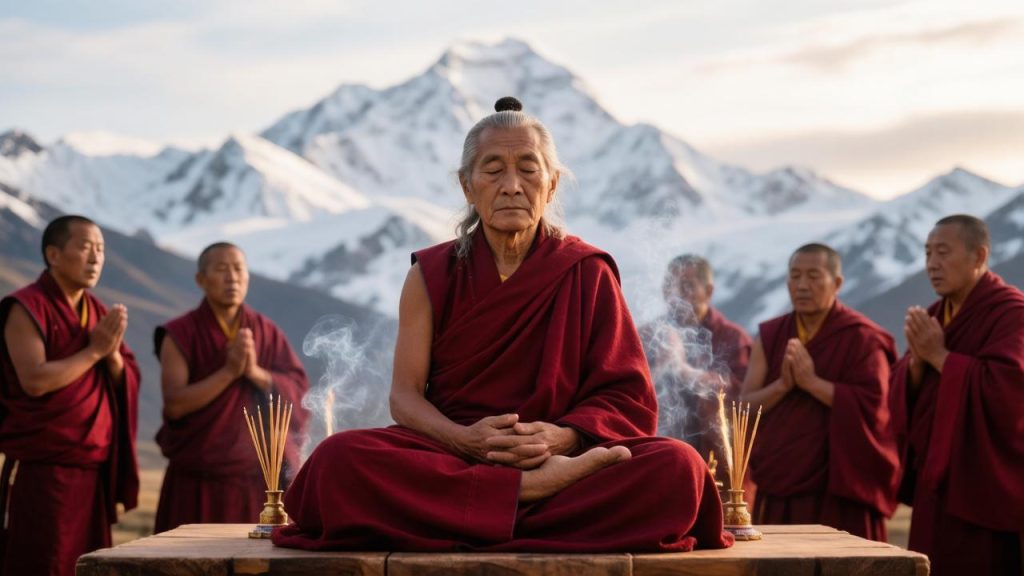
The meeting in Dharamsala began with a speech by Buddhists who outlined their understanding of consciousness, noting that from a Buddhist point of view, there are primary and secondary consciousnesses.
Let me first tell you about the primary or gross levels of consciousness, of which there are six. The five types of consciousness are connected to our senses ― responsible for sight, hearing, smell, touch, and taste. The sixth level ― It is a mental consciousness that has many sublevels. The coarsest of them is the level of conceptual thinking, and the most subtle is clear light, which in Tibetan is called “ass”. It is he who will be crucial when we come to the description of the tukdam posthumous meditation. So, all six main types of consciousness change from one moment to the next. For example, now I’m looking at a girl who is sitting in the third row, while my visual consciousness is activated. At the same time, I hear the sounds of a working camera, and at these moments my auditory consciousness is involved.
In English, the terms “mind” and “consciousness” are synonymous. From the Buddhist point of view, mind is a broad category that includes experiences corresponding to all six types of consciousness. My visual consciousness is active when there is a form in front of me. I see an object, like a camera, and I start thinking about what quality it is. This is how I use mental consciousness, or rather, its grossest level, related to conceptual thinking. As a result, I have some intuitive guesses, hypotheses. This is also an example of the activation of mental consciousness, but more subtle.
When starting to study, a serious Buddhist practitioner should at the first stage study the texts in depth and combine what he has read with his daily experience. Meditation is one of the methods of [comprehension]. By concentrating, you can get deeper into your mind. Relying on Buddhist methods, many [contemplatives] have achieved deep knowledge of their own mind.
By practicing meditation, we can awaken more subtle levels of non-conceptual consciousness. But sometimes, even without meditation, we can see a clear light. This light is not like the light from a light bulb, it is something like inner luminosity, inner clarity, which is maximized. When we yawn, sneeze, have an orgasm, and also at the moment of death, this clear light mind manifests. But if the above experiences cannot be contained ― they come very quickly and leave just as quickly ― then meditation allows us to retain the experience of clear light.
There are also secondary levels of consciousness. Among the various classifications, there is a generally accepted one: it refers to 51 types of secondary consciousness. Many of them are similar to emotions and are fleeting in nature. These include compassion, envy, and anger. There are five more that are always present. We call them the “five constantly present types of secondary consciousness.”
So, when Buddhist scientists presented their picture of consciousness at the meeting I mentioned in Dharamsala, I was sitting in the front row and noticed the reaction of the psychology professors: they were shocked. They were amazed at how close the Buddhist description of the mind is to what psychology suggests. This, of course, was followed by two days of debates and discussions; agreement was reached on some points, differences of opinion remained on some, but overall there were more similarities than differences.
What else does it say about the similarity of Buddhism and modern science? They are also brought together by the law of cause and effect, which underlies reality. The existence of a causal relationship implies changes from one point in time to the next, which means that everything, including our mind, is constantly changing.
I would like to mention another area where there are great similarities between Buddhism and modern science. A few years ago, I came across a Buddhist text on embryology, which described in great detail what happens immediately after conception, at the moment when the embryo has not yet formed, that is, immediately after the egg has joined with the sperm. I studied embryology at the university, and therefore I can say with confidence that everything that was stated in this Buddhist text corresponded to scientific ideas about the development of the embryo. It is important to remember that all these texts were written long before microscopes appeared.
I told you that I do not consider myself a religious person, and in this regard I mentioned that Buddhism is viewed from several positions. You can consider Buddhism as a science, you can see philosophy in it. We usually refer philosophy to the social sciences, because sociologists rely on logical analysis when making decisions. Buddhist philosophy mainly deals with two things ― compassion and especially with the highest form of compassion, which in Sanskrit is called “bodhichitta”, [and wisdom]. “Bodhi” means awakened, “chitta” means mind. Here, awakening is understood as an adequate perception of reality.
What is an adequate perception of reality? Most of us believe that the picture of the world that our organs of perception form corresponds exactly to reality. For example, I’m looking at the air conditioner right now. An image appears in my mind, and by labeling it, I call this item an air conditioner. I think I really see the air conditioner. And hardly anyone in this room would have defined this subject differently. Does anyone here think that we are not really dealing with an air conditioner, but with a mental picture that arises in our mind? How do we know if the air conditioner is in front of us or just a mental image? This is a very important question for a Buddhist. Because when a Buddhist begins to immerse himself in meditation and analyze his consciousness, he discovers that he is actually surrounded by mental pictures, not real objects. And these mental pictures are actually as much determined by our internal factors as by our external ones. By internal factors, I mean verbal designations that significantly color our perception of the world. That is why Buddhists very often refer to the mind as the creator of the whole world.
I have given this example of philosophical reflection in order to give you some idea of what emptiness is (Skt. “shunyata”, English “emptiness”). The English term does not fully convey the meaning of the concept of “emptiness”. When some people hear the term “emptiness,” they interpret it as “the absence of anything.” But the Buddha taught something else: he taught how to get rid of suffering and become happy. Because if nothing exists, then there is no suffering, there is no ourselves, there is no Buddha, there is no Buddhist teaching, and it is not clear why we need life at all.
The Buddha did not teach nihilism. He called for eliminating the fallacy of our worldview. The elimination of this error is emptiness, shunyata. The mistake lies in the fact that we consider the mental images that arise in our minds to be real. The Buddha said that everything is like a dream, in the usual sense of the word: when we wake up, we realize that we were just dreaming.
Imagine that you are an archaeologist and went on an excavation. You go to bed at night, fall asleep, and discover the world’s oldest skeleton in your sleep. Of course, you are incredibly happy, thinking that Moscow will give you a big medal for your research. Then you wake up and ask yourself: where is the skeleton that I just found at the dig? And you realize: oh, yes, it was just a dream.…
Buddhists say that all real reality has the same property. Reality means everything, including ourselves. Awakening is a metaphor. At the moment of Awakening, we descend into the very depths of our own consciousness and realize emptiness. This is how we get to deep wisdom and realize that all the mental pictures we live in are wrong.
But you may ask: what is real? And that’s a great question. The Buddha said that it is very difficult to realize this, you need to go step by step. When we manage to discard all that is erroneous, what remains is the true reality. There are no short paths to this state. This is a gradual path.
And finally, if we bring to the fore the ritual component of Buddhism, we can call it a religion. As you know, there is no creator god in Buddhism. This is another important point in the conversation about whether Buddhism is a religion or not. Almost all religions, with the exception of Jainism, recognize the existence of a creator god who created the world.
But if there is no God, how did the world come into being? Buddhism explains the origin of the universe by the law of cause and effect. If we begin to trace the causes of the body that we possess today, we will first analytically reach our parents and the moment when the egg and sperm merge. Then to our parents’ parents. If we talk about the Kalmyk people, we can trace the history of their 400-year stay in Russia, and then return to Mongolia, during the era of Genghis Khan and earlier. And then to the first person whose skeleton we discovered in a dream during excavations. And if we adhere to Darwin’s theory, then this will be preceded by other forms of life, and they will be preceded by chemical components, carbon compounds. And eventually, we’ll get to what science calls the Big Bang. The molecules that are now contained in our body are related to the molecules of the Big Bang.
And what happened before that? Buddhism says that every phenomenon must have a cause, even the Big Bang. It is curious that today some scientists are beginning to write that the Big Bang could not have appeared out of nothing. The point from which it originated and which possessed tremendous energy must have had a reason. And today, scientists have no choice but to say that there must have been a series of big bangs, one after the other. And the Buddhists say: We knew that a long time ago. Consequently, another area where modern science finds common ground with Buddhism is cosmology.
You and I have traced the origin of our physical body to the Big Bang and beyond. And what happened to our consciousness? How many of you admit the possibility of reincarnation? I think many people believe that there is such a possibility, but there is no scientific evidence to confirm this. Let’s look at the process of reincarnation through the eyes of a scientist. I want to tell you about Dr. Stevenson, who worked at the University of Virginia. For thirty years, his research has been devoted to the issues of reincarnation. At the same time, he is not a Buddhist and generally not a religious person. Rather, he is a scientist to the core who believes only in objective analysis.
He found the idea of reincarnation interesting, and he decided to devote his life to studying it. He had a whole team of researchers. They conducted interviews with children who claimed to remember their past lives. He repeated interviews with those whose descriptions of past lives did not contradict the real facts for several years.
In the end, his research amounted to four volumes. 15-20 years ago, I personally acquired all these books to donate them to the Library of Tibetan Writings and Archives in Dharamsala. I couldn’t read all the volumes because they were written rather boring. But when Dr. Stevenson published a small book, “Twenty Descriptions of Children who Remember Their Past Lives,” which was easy to read, I studied it from cover to cover. There really were no contradictions in what was described in this book.
In the 50s and 60s, a girl was born in Delhi, who at the age of Ten or eleven began to claim to remember her past lives. It became a sensation. Even the mayor of Delhi was involved in this story. The girl constantly asked her parents to take her home, and they began to think that the child had some kind of mental abnormalities. Not knowing what to do, they finally agreed to her pleas. The daughter took them to a village in the vicinity of Delhi, where she had never been before. At the same time, she described in detail the entire route and the house she would be looking for.
Arriving at this house, which fully corresponded to the description of the girl, her parents met the couple and explained what brought them to them. They burst into tears in response and told me that they had lost their daughter in a car accident twelve years ago. The conclusion was obvious: the girl had actually lived in this house in her previous life.
In the end, the child had two families: one from this life and the other from the past. This news made a lot of noise.
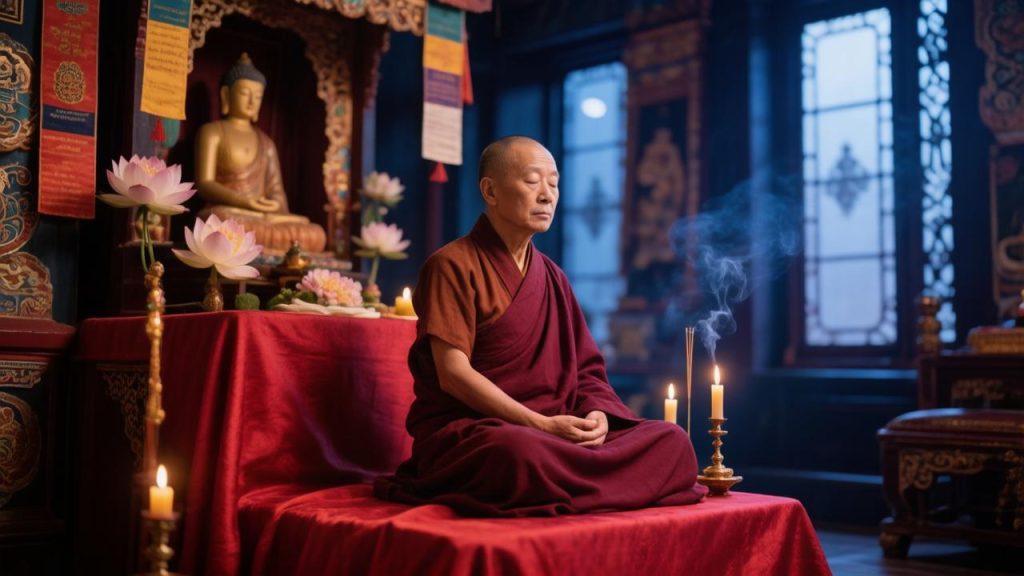
But let’s try to speculate on the subject of reincarnation. I said that human consciousness is constantly changing from one moment to the next. This means that the consciousness that we have now has a reason, and this reason lies in the previous moment of awareness and so on. And if we keep going back like this, we’ll get to the moment of our birth, and then to the moment of conception. Buddhism says that the mind is able to connect with an object that is formed by the fusion of an egg and a sperm. And if we take a single step back from this object, we will find ourselves in a previous life. Then we can go back even further ― to conception in a previous life, take another step back to the state of death and get into the life that preceded the last one. If we go back like this, we will reach the Big Bang again, but we will not be able to stop there either, because there will be no obstacles: there is always some previous reason, that is, the previous moment of awareness that gave rise to the next one.
That’s why Buddhists claim that the continuum of mind, the stream of mind, is beginningless. And this is exactly how, based on logical analysis, they explain the concept of reincarnation, which correlates with the natural law of causation.
Now I want to tell you about the Buddhist understanding of death, which brings us to the topic of tukdam ― posthumous meditation. I want to present to you a new concept of life and death based on energy. I will try to explain the pattern of multiple births in terms of the energy that moves from the gross to the subtle and back to the gross. This principle applies to both the body and the mind: the body becomes thinner when we die; when we are reborn, it becomes gross again.
The same thing happens with our consciousness, the rough forms of which we mostly use. At the time of death, we move to a non-conceptual, very subtle consciousness. Then we are reborn, and again our consciousness becomes gross.
It’s a pretty simple scheme. It happens over and over again ― there is no beginning and no end. Death can be called the end, but in a broader sense, there is no end. Everything is much more complicated than it seems. Remember, I told you that at the moment of sneezing, yawning, deep sleep, falling asleep, coming out of the dream state and sleep state, as well as during orgasm, we can experience a state of clear light. That is, this transition from gross forms of consciousness to more subtle ones occurs not only at the moment of death, it repeats itself many times throughout life. As for the body, its refinement occurs only at the moment of death.
According to Buddhism, death is the separation of the subtle mind from the body. And the subtle mind is always associated with a subtle form of energy, which is called the “subtle body.” Sometimes it is difficult for scientists to agree with this, because we cannot see, touch, or measure subtle energy in any way.
So, the grossest level of the mind is the mental consciousness, which is associated with thinking. But as the number of concepts decreases, the mind becomes thinner and thinner. There are many levels of the non―conceptual mind, and the most subtle of them is the clear light mind.
From the point of view of Buddhism, at the time of death we go through eight stages: from the grosser to the more subtle. The first four are related to the body, the last are the refinement of our mind. First, the earth element (the element of strength) begins to dissolve, and it seems to a person that he begins to sink and fall through, and his limbs become very heavy. Then the element of water begins to weaken: people feel thirsty, sometimes their eyes fall in. Then the fire element weakens, and the dying person freezes, even if you wrap him in a lot of blankets. The next stage is when movement stops, blood circulation stops, the heart stops pumping blood, and the lungs stop breathing. At this point, doctors usually declare death. This is what is universally called clinical death, but Buddhists will say that this is not death yet, because only four stages of dying have passed, and there are only eight of them.
Starting from the fifth stage, the mind becomes refined, moving to subtle non-conceptual levels of consciousness: white radiance, red increased radiance, black threshold and clear light. At these stages, there is no conceptual thinking, dual perception ― the division into subject and object. At the stage of white radiance, we experience only white radiance: there is no feeling that there is an external white radiance and that there is an “I” who feels it.
Thus, this is a very subtle state of mind ― non-conceptual and non-dual: there is no division into subject and object. If a person has learned throughout his life to manifest the mind of clear light, then, having reached this stage at the time of death, he will also enter a state of meditation. This state is called the meeting of the mother’s clear light mind and the son’s clear light mind. If a person is able to recognize this condition, they can maintain it without leaving the body. This state is called “tukdam”. “Tuk” is an exalted Tibetan term to describe the mind, and the term “dam” has many meanings, but is used here to mean “holy.”
Doctors call a person in a state of tukdam dead. Death is fixed, but the body does not decompose, it retains its freshness and everyone who is near it feels joy.
Two years ago, the head of the Gelug school, Lobsang Nyima, entered the state of tukdam. It was amazing! Residents of the surrounding villages came to this meditating deceased man for a blessing. There were a lot of journalists: the news spread through many media outlets. Local doctors also came to see it, shocked that such a thing could happen.
If a person is able to maintain such a meditative state for more than eighteen days, then other changes occur. Eight years ago, another case was reported in eastern Tibet in the province of Kam. The contemplator went through eight stages of dying, his heart and breathing stopped, but he continued to meditate, remaining focused on the clear light for a long time. Then his body began to shrink and shrink until all that was left of him were his hair and nails. After that, arches of rainbows flashed in a completely clear sky and remained there for several days. Everyone saw it. The gross body of the yogi dissolved and took the form of a more subtle luminous body.
If someone asks me, as a doctor, how to explain this, I will answer: I do not know, but I believe in it. Because I’ve been around people who were in a state of tukdam three times. These are completely unusual experiences. His Holiness the Dalai Lama also tells about such cases, and he would never invent them. He is a bright and gifted person and it is very difficult to deceive him.
We do not yet have a scientific basis for the dissolution process, but scientific research at the University of Wisconsin-Madison continues. And within the framework of this study, scientists are trying to establish what is happening in the state of tukdam. Two people, Lobsang Nyima and one Geshe, who recently passed away, have already been studied as part of these studies.
His Holiness the Dalai Lama, encouraging such scientific research, has repeatedly asked elderly monks to agree to research the condition of tukdam. Then neuroscience will be able to better understand what the mind and its subtle manifestations are, which will make it possible to understand what death is and at what exact moment it occurs.
In addition to the above-described signs of awakening and relics emerging from the body after cremation, practitioners’ realization is also judged by a phenomenon called Tukdam. Tukdam is a meditative state of mind that a realized practitioner is able to maintain even after death. This state indicates high stability in meditation, and it is very easy for anyone to notice it. This has happened to many masters of the past and present. A characteristic feature of Tukdam is that after death, the body does not decompose, does not stink, does not lose temperature, and the skin does not lose its color As long as the deceased master is able to remain in this meditative state, his body retains a meditative pose, a pleasant smell, and looks as if he just fell asleep. Tukdam can last for different times, but usually its duration corresponds to the stability in meditation achieved during life. There are two types of Tukdam — the highest type happens when the master has achieved the realization of luminous wakefulness, and at the time of death, when the experience of the clear light of the Foundation begins, he simply realizes this state and his mind merges. This is called the “merging of the clear light of mother and son.” This experience can last for several hours or several days, which largely depends on the degree of realization and the desire of the master himself. The duration of this Tukdam is not so important, because enlightenment in this state occurs in a few moments, and the rest, as they say, is “a matter of technique.” Tsoknyi Rinpoche told me that in order to achieve enlightenment at the stage of experiencing the clear light of death, it is enough to maintain awareness of the nature of your mind for as long as it takes for seven hand waves. But in order to keep your mind aware after death for at least that long, you need to develop a certain stability in it during your lifetime. If there is no such awareness, then there is no chance of achieving it after death.
The second type of Tukdam occurs as a result of high stability in the meditation of calming the mind, known as Shamatha. In this case, the deceased practitioner is also able to remain in a meditative state after death, preserving signs of life in his body. But this type of Tukdam is radically different from the previous one, since such a person has no control over his condition and the duration of Tukdam, which can be as much as a hundred years or more. In this case, the mind falls into a lethargic state due to the fact that the practitioner constantly looped it in an absent state of thoughtlessness, striving to achieve complete conservation of mental activity. This type of Tukdam is typical for practitioners of lower meditation methods, and from the point of view of the higher paths of Vajrayana Buddhism, it is considered a spiritual trap. Nevertheless, in the lower paths of Buddhism, such a phenomenon is considered a miracle, and practitioners who achieve it are exalted as saints. Tulku Urgyen Rinpoche said that it was not uncommon to find practitioners in Tibetan caves who remained in this lethargic state for five or six hundred years.