
A reminder for yoga practitioners:
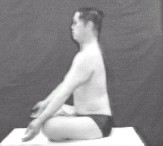
Breathing is the most important physiological function of the body: without breathing, human existence is impossible. A person breathes continuously from birth to death.
Yoga, Chinese Qigong and other teachings that have existed for several millennia and have been continuously transmitted since ancient times – they all focus on the secret power that lies in breathing, and reveal various breathing techniques that serve both to heal the body and for spiritual development.
Recently, official medicine has discovered an amazing therapeutic and health-improving effect from the use of traditional breathing methods, which have become the subject of close attention from medical scientists.
The effect of breathing techniques from the point of view of modern medicine
To live, all living beings need to breathe. In the East, it is believed that with the help of breathing, a person receives vital energy. For a better intake of this energy, the process
breathing is recommended to be consciously controlled. This control is the essence of pranayama breathing techniques.
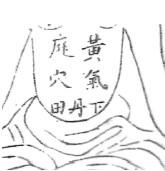
The holy yoga scripture “Hatha Yoga Pradipika” says that with proper breathing, any disease disappears.
In the medical books of ancient China, it is written that with strict observance of the rules of breathing, you can live up to 360 years.
The main point of these rules is breathing, in which a person tries to collect his consciousness in the part of the abdomen that is located below the navel. This type of belly breathing is known as “Tanden breathing.”
Recent medical research has shown that Oriental methods of breathing, which are based on belly breathing, have an amazing effect on the entire body.
Japanese Professor Muraki Hiromasa, who has been conducting research on various breathing methods at the Medical Department of the University of Tokyo for many years, says the following about the law of breathing, especially the effect of Tandem breathing: “The law of breathing is, of course, the correct way of breathing. I think a lot of people think that even though they haven’t been taught how to breathe since they were born, they’re great at it. However, few people know that with proper breathing, you can get a huge and amazing effect.
The most impressive result of breathing with the lower abdomen (Tanden) is a dramatic increase in the natural ability to self-medicate. I am a doctor myself, and therefore I cannot make absurd claims that breathing in the lower abdomen alone can get rid of all diseases.
But at least adult diseases such as cancer, diabetes, hypertension, liver, kidney, and stomach diseases, including mental illnesses, are all cured naturally by belly breathing (Tanden). Moreover, the consumption of medicines is reduced to a minimum. This amazes people who consider it an undoubted fact that it is possible to recover from diseases only with the help of drugs and operations.”
Doctor Beppu Makoto, head of the surgical department at the Hyogo Prefecture Hospital in Japan, says the following: “Observing how widely various breathing methods are used in folk medicine, one wonders if these methods cannot be used officially. Then the biological and medical significance of breathing techniques can be explained theoretically.
I tried to test this technique on myself, and my senile eyesight improved, and the herpes that I had suffered from for many years finally disappeared around my eyes. Besides, the colds stopped.
A clear decrease in blood pressure, blood sugar and cholesterol levels. significant reduction of inflammatory processes in patients suffering from chronic rheumatism, refusal of hormonal drugs in patients with decreased thyroid function – all this occurred in patients as a result of an experiment with breathing. This effect amazed even me.”
A recognized authority in the field of medicine, Professor Tatetsu Ryotn, in his interview with reporters, said the following: “It is impossible to statistically reliably interpret the clinical results of using breathing techniques alone for cancer treatment if other treatment methods were used at the same time, but as a clinical practitioner, I feel the effectiveness of using breathing techniques to prevent relapses and prolong the lives of terminally ill people. For example, we were amazed at how three months after the start of breathing exercises, cancer growth stopped in patients with breast cancer and lymph node metastases.”
Thus, the healing effect of breathing techniques is now recognized by many doctors. What are the reasons for improving health through breathing exercises?
Massage of internal organs
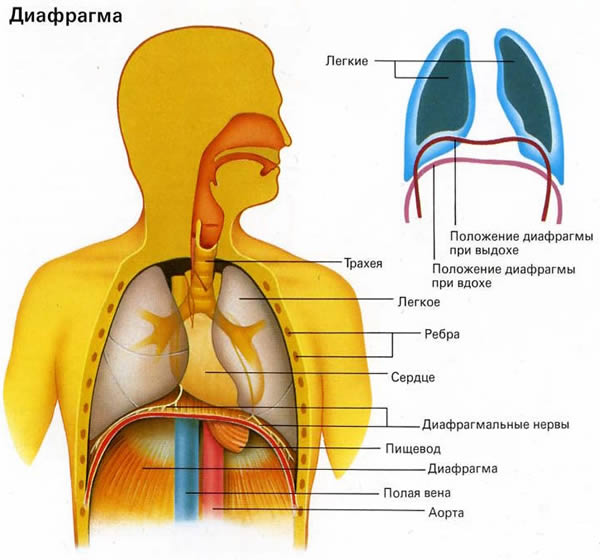
The basis of the eastern method of breathing is deep abdominal breathing. In this case, the main respiratory muscle, the diaphragm, plays an important role.
The diaphragm, like the dome of a parachute, completely covers the internal organs of the abdominal cavity, separating it from the chest cavity.
When a person exhales deeply while breathing through his stomach, the diaphragm, contracting strongly, has a mild stimulating effect on the internal organs. As you know, such a massage of internal organs with the help of a diaphragm leads to a significant improvement in blood circulation throughout the body.
The human heart… In modern medicine, the heart is considered a pump that provides blood circulation. But the heart differs from a conventional pump in that, while it can forcefully expel blood, it cannot actively suck it in. The heart can send blood throughout the body only after the spent venous blood returns to it. However, polluted venous blood tends not to return back to the heart, but to linger in the internal organs.
In medicine, this is called “venous congestion.” Stagnation leads to deterioration of the internal organs and causes various diseases. A very effective means of eliminating venous congestion in the internal organs is the oriental method of breathing. Massage of internal organs during abdominal breathing, providing moderate pressure on them, eliminates stagnation and directs more blood to the heart. Therefore, the diaphragm is sometimes called the “second heart.”
Professor Muraki Hiromasa explains the action of the diaphragm during abdominal breathing: “Usually the diaphragm is not very mobile. However, if you exhale deeply with your lower abdomen, this “parachute” will contract (similar to how an umbrella closes) and compress all internal organs. This massage of the internal organs covers the stomach, liver, kidneys and other organs, stimulating them as much as possible.
As pressure is applied to the entire abdominal cavity, venous blood rushes faster to the heart. Further, during inhalation, the diaphragm, opening like an umbrella, returns to its previous position, allowing the internal organs to relax and absorb clean arterial blood. This blood is then sent back to the heart, and then supplied to all the muscles and organs. Thus, blood circulation in the body improves, the overall recovery of the body occurs, the blood reaches the brain cells, and due to pure blood, the work of the heart and brain is revitalized.”
By the way, if you master the eastern method of breathing perfectly, amazing changes will occur in the movements of the diaphragm.
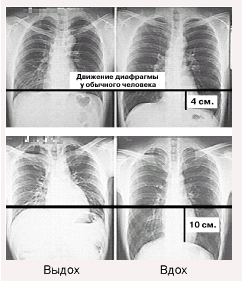
The upper image shows the amplitude of the diaphragm movement of an ordinary average person. When inhaling and exhaling, his diaphragm lowers and rises by 4 cm .
For people who master yoga, the diaphragm rises and falls by 10 cm (bottom picture). This is more than twice the rate of an ordinary person.
The amplitude of the diaphragm movement is directly related to the function of respiration. If the amplitude is small, then the person is only capable of shallow, ineffective breathing. Conversely, when breathing exercises increase the amplitude of the diaphragm movement and produce deep, effective breathing, the stimulation of internal organs increases and blood circulation throughout the body improves significantly.
Prostaglandin 12
As for the lungs, in order to increase the area of contact with air, the terminal part of the trachea is transformed into countless small sacs in the pleural cavity (the pleura is the membrane covering the lungs).
As a result of recent studies, it has been found that with deep breathing, the pleura swells strongly and begins to secrete a substance with amazing physiological activity. This substance is prostaglandin 12.
Kitamura Satoshi, a professor at the Medical Institute, says the following about the effect of this substance: “During respiration, the pleura of the lungs secretes a substance called prostaglandin 12 to increase its effectiveness. This substance lowers blood pressure and prevents sclerosis. It has the following properties:
- Dilates blood vessels and reduces blood pressure.
- Prevents blood platelets (platelets) from sticking together.;
- Prevents the formation of cholesterol in the blood and the deposition of fat on the walls of the arteries.
- Prevents the release of catecholamines, hormones that contract blood vessels.
Let’s consider the above effects in more detail.
Prostaglandin 12, which dilates blood vessels and lowers blood pressure, also has a powerful effect on peripheral vessels, dilating them and thus lowering blood pressure throughout the body. Vasodilation not only reduces blood pressure, but also improves blood flow to all parts of the body.
In addition, since prostaglandin 12 slows down platelet clumping, this leads to improved blood circulation and slower thrombosis. And this prevents stroke and heart attack.
Prostaglandin 12 prevents the deposition of cholesterol and fat in the blood on the walls of the arteries, and this, in turn, prevents atherosclerosis.
Finally, prostaglandin 12 prevents the release of catecholamines.
If a person is angry, agitated, or afraid, catecholamines are released in their body. The release of these substances leads to vasoconstriction.
If catecholamine is injected into ordinary blood vessels, they contract so much that they become almost invisible (see photo). And vasoconstriction causes difficulty in blood circulation and increased blood pressure. In this case, there are obstacles to normal blood flow.
As a result of the action of this hormone, the blood plates change (see photo below) The picture on the left shows ordinary blood. After catecholamine enters the normal blood, it becomes thick, and the formation of new platelets becomes difficult.
Catecholamines have a terrible property: by binding to active oxygen, they contribute to the development of atherosclerosis.
Diseases caused by these substances will soon take the first place among the diseases from which Japanese people die.
However, due to the deep breathing technique, prostaglandin 12 entering the body inhibits the release of catecholamines and thereby prevents the occurrence of many diseases.
Right now, at the beginning of the 21st century, Eastern wisdom is lending a helping hand to European medicine, offering a healing method of breathing. Respiration is the main physiological function of a living organism. By controlling our breathing, we can be cured of various diseases. But not only that. We can become people full of vitality.
Gay Hendricks, PhD, a professor at the University of Colorado, says the following: “The breathing method is one of the areas of research with exceptionally rich possibilities. I have been practicing a special breathing method for many years, but I don’t stop discovering something new all the time. In short, as I practice this method of breathing, I increasingly feel and recognize its hidden possibilities. As breathing exercises enter your life, various miracles will surely happen to you.”