
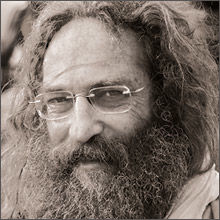

We bring to your attention a fragment from conversations with an interesting teacher, Rampuri Baba. An American by birth, in 1968 he first came to India for the purpose of spiritual search.In 1970, he met his Guru, Hari Puri Baba, and was initiated into the Juna Akhara spiritual order, one of the famous communities of wandering ascetics, sadhus or baba (“father”, emphasis on the last syllable), as they are often respectfully called in India.
He spent most of his life in India, deeply immersed in its oral traditions and the secret world of yogis and ascetics. His book “Biography of a Blue-eyed Yogi” (Moscow, Gayatri Publishing House, 2006) has been published in Russian. It is a fascinating and frank work that opens the veil over the harsh world of sadhus – a kind of spiritual “state within a state”, a dimension where many traditions have not changed for centuries, if not millennia. In 1984, he became one of the council of elders of Jun Akhara, one of the few “whites” recognized by Indian spiritual authorities.
We met him in the south of India, in Goa, a small state that is familiar to most as a beach resort, but in the sacred geography of India it has a different meaning – Goa and neighboring Maharashtra are patronized by Dattatreya (a deity combining the power of Brahma, Vishnu and Shiva, a yoga teacher and aghori) and his disciple Parasurama, one of the immortals, a formidable warrior who later became a yogi, mentioned in the ancient epics Mahabharata and Ramayana. We spent several warm evenings talking about Indian spiritual culture, great teachers, extreme ascetics, and much more. The oral tradition of wandering ascetics, which Rampuri had been learning from direct experience for many years, is full of interesting stories and biographies of saints that are not found in Western Oriental literature. We touch on many issues, something resonates, something is intertwined with other topics, something escapes… This is a way of transferring knowledge, when the students sit around the campfire and the conversation is relaxed, and not in the form of a thematic lecture.
Ilya Zhuravlev, Timofey Rakin
“The idea of the existence of a certain religion “Hinduism” was created by Western imperialists out of a desire to describe the world according to their system of values”
Conversations with Rampuri Baba
Famous spiritual orders of Sannyasins (“renunciants”) Saraswati, Giri, Puri and others were founded by the famous teacher Shankaracharya. There are different dates of Shankaracharya’s life and different versions of his mission, some views are described by Western Orientalists who classify him as the founder of Advaita Vedanta, a religious and philosophical doctrine described in encyclopedias that denies ritualism and worship of various forms of Deities other than the impersonal Absolute. On the other hand, looking at Indian sources, we see that Shankaracharya worshipped Shiva, practiced the shaktist tantric tradition of Sri Vidya, and wrote a heartfelt hymn about Krishna bhakti… The sadhus of your order worship Dattatreya.
Rampuri Baba: I’ll tell you what’s going on here. In 1972, I met Dutch Professor Fritz Stoll in India, a remarkable orientalist educated in the fields of Vedic religion, rituals, Sanskrit grammar, and philosophy. He invited me to visit the Department of Oriental Studies at the University of Berkeley, in the USA, which he headed. By that time, I had already been initiated into the Puri Order and had been living in India for five years, wandering with Baba, speaking Hindi fluently, and learning Sanskrit. I was 24 years old at the time and I looked at my money reserves – I only had a few pikes in my bag – I didn’t even have enough for tea. And I began to think – now I will grow up and what will I do, how to earn money? Now I could become what is called a yoga teacher in the West, but in those years, if you claimed that the masses of ordinary people would practice yoga, you would be taken to a mental hospital. Back then, in the West, it was believed that yoga was for crazy people, hippies taking psychedelics, etc. And I thought, maybe I should become a professor of Oriental studies. So I decided to return to the States. I went to Professor Stoll and told him that I was getting old, I was 24, and I was thinking about my future. He said that I could attend any of his courses for free and participate in his dissertation. It was very interesting for me, because all the knowledge that I acquired in India was traditionally passed down by word of mouth, and I did not have in my head a systematization of what I was studying. I knew mantras, could tell traditional stories, and knew how to make a dhuni (ritual hearth). There were no classes or lectures in India, where I received instructions from a pandit and then told him what I had learned, I had to learn everything by heart, these were the same words that were pronounced thousands of years ago somewhere in Varanasi, I did not have to think. And at Berkeley, I was amazed at the systematic presentation of knowledge – here is the library, here is one course, the second, here are the expert professors. For a whole year I studied 18 hours a day, I thought – now I have real tools for India. Now, I have all the information, I know the historical context, about the Aryan invasion, etc. And a year later, I returned, ready to conquer India. And I ended up like a locomotive that crashed into a brick wall. I went back to my babas, to my Guru, and talked about the Aryan invasion and the historical perspective. They asked: Who told you such strange stories? All my tools didn’t work. I realized that there are two types of knowledge – local, Indian knowledge, and academic knowledge about India that originated outside of its borders. And they exist in parallel, but they never intersect. It’s the same story with Shankaracharya. When I was writing my book, I had a choice – which date of Shankara’s activity to put – 780, as in academic books, or 500 BC, as it is considered in the Indian tradition. How did this date come about? First, there is the text “Shankara Digvijaya” – “The Great Victory in four directions”. This text provides complete information about the sky map of that time, and the dating can be determined by the position of the planets. Secondly, there are records of lineage in the maths, the main monasteries of this lineage. One of the most important is Shringeri Math in Southern India, it is the home math of Shankara, where there is a continuous line of transmission, the origins of which are about 700 years BC. All dates are recorded, because there are manuscripts of offerings to the temple, who donated money when, and the name of the mahant (head) of the monastery. To this day, this tradition is alive – to make such recordings. They also date events from the time of the Buddha, etc.
In general, the idea of “Hinduism” or “Buddhism” is no more than 100 years old. The idea of the existence of a religion called “Hinduism” was created by Western imperialists out of a desire to describe the world according to their own system of values. It is impossible to evaluate the ancient world from the point of view of the modern one. If you look back a couple hundred years, these boundaries between Buddhism and Hinduism are disappearing. There remains the concept of Dharma, spiritual teaching. If you look at Tibet with its tantric lamas and yogis, they are much closer to the Indian naga babas than, for example, to the monks of Sri Lanka or Thailand.
Tibetans have nagpa yogis who wear earrings, long hair, and worship Mahakala. In Nepal, I saw a Tibetan baba with dreadlocks who lived in the Gorakhnath ashram, and when asked, he replied that “there is no difference – this is Guru Rinpoche.”
Rampuri Baba: I’ll tell you why. There are 52 lines in the Juna Akhara order. 16 lines of Puri, 14 Giri, 13 more Giri, these are forty-three lines, 4 Bharati, 4 Saraswati, these are fifty-one, and the fifty-second line is called Lama. There was a teacher named Kamal Baba who lived in what is now Pakistan, in the area of Peshawar, near the Afghan border. This area was also called Uddiyana. Kamal Baba visited Tibet and had students there. There he was called Guru Rinpoche or Padmasambhava, and his lineage was called Lama. And within our Akhara, Tibetan lamas from the lineage of Padmasambhava, Guru Rinpoche, are recognized. Maybe many Tibetans don’t know about this, because Padmasambhava just appeared in Tibet, but for us he was one of the babas who went to Tibet. He is even depicted with a trishul (trident). like a sadhu. Many years ago, I visited Ladakh with my close friend Bir Giri baba, with whom I ran an ashram in Haridwar, he was a big man with big jatas (dreadlocks). Wherever we went, the locals called him “Guru Lama.” So many academic books that carefully draw a distinction are written by thinkers who have no contact with the living state of things.
A few years ago, I talked with David Frawley about the Aryan invasion, and I told him that it was necessary not to prove the fallacy of this theory, as he does, but to show that an attempt to get into the history of India with such a theory is basically absurd. Show me at least one traditional community in India that adheres to this view, if there is a small echo of this theory in any tradition… But there is nothing like that.
In other words, history was created in the last 150 years, during the conquest of India. Even the name India was created by the British, in the Mahabharata there is a name Bharata Varsha.
Rampuri Baba: Yes, it was done to gain more control over the captured country and its culture, to try to unify it. People from empires like to organize everything – one God, one holy book… “My God is true, so your God is fake. Come to my religion.” So such books are interesting for people who don’t know the real state of things.
So you still think that Shankaracharya lived so many years ago?
Rampuri Baba: This is not a matter of my personal opinion. I am saying what is passed down in my tradition. Whether he lived so many years ago, or so long ago, whether he lived at the same time as Christ… Who knows, and who really cares? He reorganized the tradition, but was not its founder.
So there was a naga baba tradition before him?
Rampuri Baba: Of course, long before him. I wrote in my book about our main Guru, Dattatreya. Dattatreya lived in Treta Yuga. Do you want to know exactly when he lived? He was a contemporary of Parashurama, and they had met many times. Naga baba are the disciples of Guru Dattatreya.
How do you know the term Bharata?
We read in the Mahabharata. Stories about rishis, apsaras…
Rampuri Baba: Do you know what the word apsara means? Aab means water, and sarah means to flow. Sarah-sarah-sarah is the sound of flowing water in a river. So, initially apsara is a nymph of water, a goddess from the river. I often advise people from Europe to try to experience the divine in their own rivers, to return to contact with the spirits of their land.
Once I lived on the riverbank in the mountains, alone for a month, and at some point I saw very clearly that I could hear some kind of singing from the river, I felt someone’s presence there.
Rampuri Baba: So you understand the difference between reading someone’s ideas in books (which is certainly not bad, and the books sell) and your own experience.
Another question is that sadhu culture is centered around dhuni (ritual hearth). They just seem to be sitting around dhuni and not doing anything else. All activities are related to fire, how to keep it alive, and if you don’t know how to do this, you won’t be recognized as a sadhu.
Rampuri Baba: And smoke always goes in your face… At first, smoke always goes in your face, no matter where you sit (laughs). As I mentioned in my book, when you live with dhuni and someone comes to visit you, smoke goes in his face. It’s like having a dog that immediately rushes to sniff a guest (laughs).
Going back to Dattatreya. He is depicted with three faces – Brahma, Vishnu and Shiva. Is this ancient iconography or not? I’ve read about other versions of his image.
Rampuri Baba: You have to be careful here. Versions are often written by young Orientalists who have completed their degree in their twenties, but their information can be sucked out of their fingers based on their own interpretation of the books of their predecessors. There is a story that Dattatreya was one of three brothers, there were three rishis – Soma, Dattatreya and Durvasa. Perhaps the artists represented the three brothers in this way.
But what does the oral tradition say about the form of murti (temple sculpture)? Dattatreyi? We have a small Dattareya temple in Arambol.
Rampuri Baba: Yes, and the Parashurama Temple is nearby.
Isn’t that where you keep padukas (ancient sandals that give the wearer mystical powers)? Dattatreyi?
Rampuri Baba: (LAUGHS) Yes, because no one will guess that they are hidden in Arambol. As for the different forms of murti, this is the difference between the Western, imperial approach, which seeks to unify everything so that it is easier to rule the world, and the Dharma. In the West, people often say, “My God is true, so yours is false. If you want to be saved, accept mine.” But in India, no one is afraid that there are many Gods, many murtis, and, moreover, the Gods often “live” in certain places. One place is considered to belong to Mahalakshmi, the other is inhabited by Shiva. Dattatreya is the God of Maharashtra, his place is Mount Girnar, Gujarat, in ancient times it was part of Maharashtra. This is in the west, and in the north is Muhurgad, in the south its place is Kollapur. Dattatreya’s home is also Mount Shayadri. And Goa’s patron saint is Parashuram. After killing several generations of kshatriyas and becoming disillusioned with the war, he became Dattatreya’s disciple and a great yogi. In Muhurgada, believed to be the birthplace of Dattatreya, there are several mountains similar to the shivalingams. On one is the dhuni (ritual hearth), symbolizing the place of his birth, and on the other are the temples of Renuka, mother of Parashuram, and Anusuya, mother of Dattatreya. If you want to know something about real Tantra, then know that it has only two sources – Dattatreya and Renuka. Do you know this creepy story of how Rishi Jamadagni called his seven sons and asked them, “Which one of you is my true disciple?” Everyone said we are your students, Father. Parashuram was the youngest son. Then Jamadagni said, “If you are true disciples, go and cut off your mother’s head.” No one wanted to, and when it was Parashuram’s turn, he took out his axe and immediately cut off his mother’s head. Jamadagni said, “You are my true disciple, who has undoubtedly fulfilled my order, now say any wish, I will fulfill it.” Parashuram asked to revive his mother again. The Rishi took his wife’s head and grew it back with mystical power. This simple story, which has many variations in the oral tradition, contains many seeds from which Tantra grew.
When talking about Tantra, three terms are usually mentioned – tantra, mantra, yantra. Take yantra, for example. It is like a haven for the Deity, like a throne prepared for him. We invite the Goddess to the seat prepared for her to pay her respects.
Can we say that yantra is older than the sculptures of deities, and was originally used by dhuni as well?
Rampuri Baba: I would not underestimate murtis (sculptures) because murtis are often planted directly on the yantra, besides very often sculptures are peculiar signs located on the ground. It is worth visiting the Mahalakshmi Temple in Kollapura and seeing Her body… Usually, if you visit a temple during puja, it is difficult to see the murti, she is covered with flowers, fabrics, etc. But when I did puja for Her, poured milk, ghee on Her head, she was naked, just a stone. The stone is very interesting, I do not know its name, it is very strange. It doesn’t look like a stone that you can buy in a store. So, murti can be a sign on earth, as if it were the signature of the Goddess herself, which she places in places of Power. That’s why we strive for these places.
Returning to Dattatreya, we read some of his texts, Tripura Rahasya, Yoga Rahasya, Avadhuta Gita…
Rampuri Baba: Unfortunately, translations are often lame, but they are English, Russian or even Hindi. It is necessary to hear the original Sanskrit of the original source. The Avadhuta Gita is written as a song (it sings a rhyming sloka in Sanskrit). The Avadhuta Gita is not a book on philosophy, it is a book of secret language and mantras. This is one of the most powerful Tantric texts, but it is difficult to understand through translation, the secret language is lost, so it is important to preserve this text in Sanskrit.
Do you know Goa Gil (DJ Goa Gil), does he also live in Goa?
Rampuri Baba: This is one of my close friends.
He came to Russia several times with concerts, gathered 12 thousand people each.
Rampuri Baba: Gil and I came to India together once, one of my oldest friends. He also belongs to the Juna Akhara, and together we will keep dhuni on the Kumbha Mela. He is from the order of Giri, and at first he was Saraswati, in the 70s he studied yoga in the mountains of Rishikesh, at Yoga Niketan, Yogeshwarananda ashram.
Interestingly, when you get into a family, in Akhara, you usually have several Gurus, diksha, shiksha, and so on.
Rampuri Baba: I had 11. Two years ago, the eleventh of them, Arjun Puri, died at the age of 150.
I have a question – how can we, people living in a mythological world, preserving ancient culture, survive in modern society?
Rampuri Baba: Yes, it’s very difficult now. On the one hand, this mythological era is over. We are forced to come into contact with the modern world in a different way than before. If earlier we wandered around India and came to some place, visited a temple, then most of the men came, there were not many women, they stay at home, this is the custom, but the children all gathered, sat close to each other and listened with their mouths open. We listened to stories about the garden from other places, about Rama, Krishna, Shiva… And recently, we were in some village, came to the temple, sat down, but there were very few people, there were no children. We asked – where are the children? One of the locals explained that they were all watching TV, American cartoons with Hindi translations. The authority of Sadu, the storyteller, is gone. For many centuries, the old man, baba, was an authority, but now attention is focused on TV – in India, the USA, Russia, everywhere… Knowledge is no longer transmitted from the mouth of one person to the ears of another, which was the basis of the garden tradition, now people watch TV or the Internet in search of information. So some religious authorities began to speak and preach on TV, they address people like advertisers to customers, because we live in the era of buyers. Previously, people turned to the babas passing through the village for blessings and advice on what to do if there were problems in life, etc. They received vibhuti (ashes from the ritual hearth), blissful touches. Now the ideology of the middle class prevails – they expect to be presented with a product, they will consider it, and if they like it, they will buy it, and if not, they will choose another product. They want to know what the Guru “has to offer,” according to their ideas, the Guru should advertise, and then they will probably acquire his “product” and become his followers. This is the exact opposite of what traditional babas used to do. Some babas have prepared for the era of buyers – they have acquired land, built large ashrams, produce products ranging from books to rosaries, and offer them to people because people want to buy something from religious authorities, and then they feel satisfied.
But wasn’t it the same before? People came to the garden, brought offerings, food, and received blessings. The material approach, even the simplest one, has always been closer to people…
Rampuri Baba: That’s how it was. The only difference is that many modern Gurus cannot give real blessings that mystically affect your life, they do not have such spiritual power. You can get information from them, lectures, books, incense, perhaps some kind of feeling of happiness, which will be called “enlightenment.” But baba doesn’t give out “enlightenment,” doesn’t even give teachings unless you’re his direct disciple. Baba is just touching you, and because he is a yogi, mystically connected with Mother Earth, he acts as a tube that transmits through his hand the blessing of Mother Earth, prosperity, to the person who asks for it. Regardless of caste and without any fee. You can give a holy person a dakshina (donation), it is a tradition. But now there is a business going on, people are buying incense, CDs, books, even prasadam in the ashram. Ashrams are thriving, but babas who live as hermits in caves, who may have a couple of disciples and who pass on thousands of years of knowledge, lose their ability to survive in the modern world. They don’t have much money, and they’re under financial pressure that they didn’t have before. Even groceries have become much more expensive. Previously, if a hermit rode on a train, the conductor understood who it was and did not ask for money, but now it is not so. Many women become more materialistic, it is a process of survival. But communicating with popular Gurus, I’m not saying that they’re all bad, but it’s different than receiving blessings from a Baba.
What is the difference between the titles Swami and Baba?
Rampuri Baba: Swami means “Lord.” It’s a term of respect. If you say “Swamiji,” it’s more specific, referring to religious activities. Baba is a closer respectful address – it can be your father, grandfather. Sadu comes from the Sanskrit word for “good man.” It also means a person who has accepted renunciation of the world.
I have heard that Swami is like an analogue of monasticism in the Western tradition, a person takes certain vows, like monastic ones, then they call him Swami. A swami must belong to some spiritual order, he cannot become one by himself. But a woman is not necessarily a monk?
Rampuri Baba: For example. In Dashanami Sannyasa, a meta-organization of 10 orders of sannyasis, there are different types of yogis and monks. Some shave their heads and carry a staff. Their main practice is the study and recitation of the Vedas, they are called Danda swami, the lord of the staff. They should be addressed as Swamiji, not Babaji. But they are also a part of Jun Akhara.
What is the difference between the different orders of Dashanami-Sannyasa – Puri, Giri, Saraswati? Could there be a difference in practice, philosophy, or the main Deity?
Rampuri Baba: There are two main directions of sannyasa. According to my experience, Guru Dattatreya is a guru of yoga and tantra, a teacher of naga baba, naked ascetics with long jata (dreadlocks), he himself was the first naga baba, and his tradition was always more shamanic, more connected with Mother Earth. Then Adi Shankaracharya appeared, academics say only dates, the tradition of the garden refers him to the 5th century BC. No one can say for sure which date is correct, and it doesn’t matter. It is important that he was from the strong Nambudri Brahmin tradition, knew Sanskrit and Vedas perfectly well from an early age, and was a man of high culture who accepted renunciation of the world. There have been additions besides the Dattatreya tradition. Adi Shankara introduced a more philosophical Sanskrit culture and acted as the organizer of the Baba movement, giving it structure and founding four main monasteries (Mathas) for all the Babas of India – Shringeri in the south, Rameshwaram, Cape Kanyakumari, Joshi in the north, Badrinath, Dwarka in the west, Gujarat, and Puri Math in the east, in Jagant Puri, Orissa. He sent four of his main students to lead these Maths. On the other hand, there were still many sadhus associated with the Dattatreya tradition, who practiced more what we call yoga and tantra – different methods of mystical contact with Mother Earth, more shamanic. To keep these energies under control, the Akhara orders were organized. The ancient name of Juna Akhara was Datta Akhara. Then there were other Akhars. The difference between them was that each Akhara, consisting of different transmission lines, had its own “main” Deity. In Juna Akhara, this is Dattatreya. Every disciple in Juna Akhara should have five Gurus, but apart from that, He is the mystical, main Guru. For example, Agni Akhara worships Surya, the Sun God. The oral tradition is not eclectic, it does not take information from any random sources. The sources of information are only Gurus and lineage members.
And how is it that Sadu Juna Akharas are considered Shaivites, wear rudraksha, but their Deity, Dattatreya, is considered an avatar of Vishnu?
Rampuri Baba: And he also worshipped Adi Shankar.
And then who worshipped the “impersonal Brahma”, wanted to “take the Gods out of the temples”, who is a real follower of Advaita in this sense?
Rampuri Baba: The main text of Advaita is Shankara’s commentary on the Brahma Sutra. Modern Advaitists often believe that anyone can take the main text and interpret it however they want. But this is different from the oral tradition. In India, the interpretation is given by a teacher from this tradition. You can’t decide that you’ve “skimmed the cream” and say, “this is the essence of milk, and we’ll discard the milk itself as a lower substance.” Then the meaning is lost. Look at the life of Adi Shankara. He’s not a professor at the university, he didn’t write anything down. He was sitting next to dhuni, wandering around India. People followed him, sought his blessing, and expected a miracle. Sometimes he would say something interesting, and his students would remember it. At that time, all the texts were sung and rhymed, and the students memorized them. Then they wandered around the country and carried them. Did you know that kokwa was one of the most interesting missions of Adi Shankara? He found places of power of the Mother Goddess all over India and marked them. He followed the Sri Vidya tradition, which is also associated with the Goddess, Lalita Tripurasundari. And near many temples of Dattatreya there are temples of Mahalakshmi or another form of Goddess. Interestingly, naga baba, a naked man smeared with ashes, who has nothing material, can give blessings for prosperity. Because he’s connected to his Mother. His body is like a contact, he does not give enlightenment or shaktipat (transfer of spiritual power) with the help of his blessings, he gives prosperity, which is synonymous with Mother Earth, health, well-being, and improvement of life.
Adi Shankara, although he followed a slightly different style than naga baba, also sought and founded Shakti-Peethas, places of radiating blessing to Mother Earth. That’s what he spent his short earthly life on, and he knew how long he would live. I have met professors who are experts in the philosophy of Adi Shankara at universities in the USA. In my opinion, they missed the most important thing. They had no idea who this man was or what he was really doing. But the reflection of his life can still be seen in baba. This is not related to the mental masturbation of academics. They told me about the superiority of Adi Shankara’s philosophy over other religious traditions, supporting it with quotes, but being in the very heart of dashanami sannyasa, I had never heard such a thing in many years of communication with sadhus and sannyasins. In my opinion, both the “demonization” of Advaita by some Vaishnavas and the pathos of academic Advaitists are very Christian in spirit, with the idea that “my God is true, and yours is false or at best a faint glimmer of the true.” It works more to cultivate the ego of the authors of such concepts.
We have seen pictures of sadhus performing cruel austerities – some have held their hand up for many years in a row, so that it dries up. Some take a vow never to sleep lying down, or not to leave one place for many years, naga baba pierce the genitals, wind the penis on a stick… Why do they treat their bodies so harshly? Is this a way to achieve samadhi, or are they trying to acquire siddhis through such austerities? After all, in hatha yoga, for example, it is believed that the body is the temple of God and it should not be destroyed.
Rampuri Baba: We don’t want to destroy the body because it is a temple, but we also don’t want to turn it from a temple into an office. I think that austerity, tapas is a part of yoga, as a connection with God. In most cases, if a person does not suffer, he cannot gain wisdom. There is a connection between suffering and wisdom. A yogi must perform some kind of sacrifice. Someone sacrifices their anger, someone sacrifices meditation in a cave, in the snow, for 12 years. Tapas comes from the word “heat”. We want to burn off all the pollution and nonsense in one lifetime. This cannot be achieved simply by singing and clapping your hands. Sometimes you have to work very hard. But for the sake of magical powers, people also sometimes perform austerities – this was done by many demons, you read the story of Ravana, with his monstrously extreme austerities, he won the favor of the Gods and they granted him immortality, he asked for protection from all creatures except man, whom he considered so insignificant that he was not afraid. As a result, Vishnu took on a human incarnation as Rama in order to kill him. This is also the result of austerity.
This is an Asuric type of austerity, when you really want something, and you sit down and do it, either death or the result. What is the difference between Sattvic and Rajasic austerities when the body is destroyed? At the last Kumbha mela, I met some very strong naga babas, it was felt that they had great willpower, but at the same time there was no sense of sattva, purity, you don’t expect help from them. Rather, you realize that they can easily curse you if they get angry, or control your mind to make you a disciple.
Rampuri Baba: It’s hard to tell who is Sattvic and who is Tamasic from the looks of it. If someone is engaged in austerities, how can he be judged by someone who has no such experience? When a sadhu practices austerities, he gains strength. And this power gives him the opportunity to pass on the tradition through time, with the help of his students. If the Guru did not suffer, if he did not take risks, if he is weak, what should he do with the disciples? Which type of tapasya is suitable for whom is very individual. Someone also needs severe austerities.
When I travel around the world giving lectures, one of the most common questions is: “What practices do you do?” My Guruji, Hari Puri Baba, knew, for example, the practices of hatha yoga, and he performed various cleansing procedures during morning ablution, in addition to brushing his teeth. But this was not an important part of his spiritual practice. Then there was a war with China, in 1961, on the border of India and China. Guruji said that many Chinese practice their own hatha yoga, there is also work with energy, etc., but it just made them more effective killers. Our practice is very simple and complex at the same time. To perceive everyone as a manifestation of nature, the Mother Goddess. You respect and worship every cell of the universe as a Mother. And when a person feels bad, their life falls apart, their children or a cow get sick, they come to you for blessings, because if you are a real woman, there is no difference between you and your Mother anymore. You touch the beggar, and his life gets better.
So you’re donating yourself to society to help everyone?
Rampuri Baba: Yes, absolutely. How the rose flower sacrifices itself to the universe. In our tradition, a woman does not put her feet behind her head and does not stand on her head. He gives blessings. Everything you do, austerities and rituals, is not for your own importance, but for people who no longer have any other hope, and you give them a little magic.
Can I take my camera to Kumbha Mela? Maybe it’s worth filming secretly?
Rampuri Baba: You can take a camera, but you shouldn’t shoot secretly. Be noble – ask permission first, and then take it off. I’ll take you through Juna Akhara. But in general, it is much better to look at such things with two of your own eyes than with one artificial one. Often people rush to “click” something they don’t even understand. Sometimes it’s better to leave the camera in a safe place and wander for a week, just looking at the world with your eyes.
November 27, 2006, Free Flow Yoga Center, Arambol, Goa, India
Rampuri Baba’s website rampuri.com
Up
Simon Borg as Oliver. “Anatomy of Yoga: Closing the circle of body and consciousness”
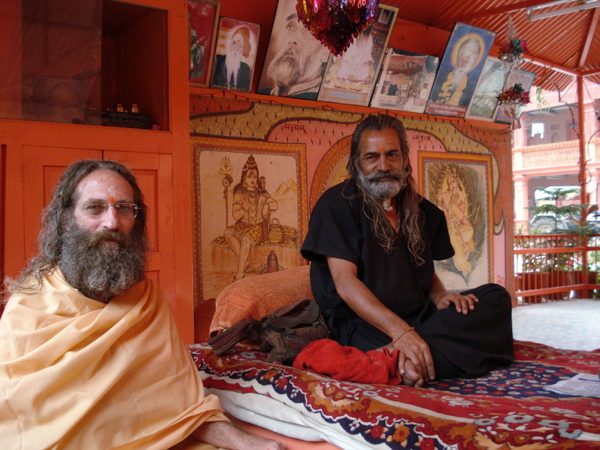
Rampuri Baba. An American by birth, in 1968 he first came to India for the purpose of spiritual search. In 1970, he met his Guru, Hari Puri Baba, and was initiated into the Juna Akhara spiritual order, one of the famous communities of wandering ascetics, sadhus or baba (“father”, emphasis on the last syllable), as they are often respectfully called in India.
He spent most of his life in India, deeply immersed in its oral traditions and the secret world of yogis and ascetics. His book “Biography of a Blue-eyed Yogi” (Moscow, Gayatri Publishing House, 2006) has been published in Russian. It is a fascinating and frank work that opens the veil over the harsh world of sadhus – a kind of spiritual “state within a state”, a dimension where many traditions have not changed for centuries, if not millennia. In 1984, he became one of the council of elders of Jun Akhara, one of the few “whites” recognized by Indian spiritual authorities.
Rampuri Baba
“In the West, people construct their own yoga and tantra”
A conversation with Ilya Zhuravlev and Tim Rakin
Ilya: Our last interview was in 2006. What has happened in your life since then? How are your books and your teachings?
Rampuri: In the last few years, I have connected to social media, through which I have been able to participate in many conversations on the Internet, to hear through the Internet the opinions of many people who are interested in yoga and the Indian tradition. This gave me an idea of what I think is happening in modern yoga and spirituality trends, not only in the West, but also in India.
Ilya: My next question is about Western yogis. Now many people in the West practice yoga. And although many of them are interested in the Indian tradition, they still, it seems to me, consider yoga as a set of exercises to improve their health. Many of them treat Indian legends like ordinary fairy tales, and consider India to be a land of magical tales and fables. Even accepting the basic principles of the dharma, it is difficult for a Westerner to blindly believe in the teachings, like ordinary Indians. This question goes back to the days when the first foreigners came to India and started practicing yoga. What do you think about this?
Rampuri: That’s how I see it. Regardless of whether foreigners view it as fairy tales because of their disbelief or whether they fully believe in it, I think in both cases it is fiction. I think there are very few people in the West who are able to discern anything about Indian culture. It seems to me that in fact, Western knowledge of Indian culture is autobiographical. When foreigners describe India, they are actually looking in the mirror and describing themselves. Due to the different nature of our cultures, the Western world represents the rest of the world, it speaks for the rest of the world, it is its representative. The Western world does not see that the rest of the world is able to represent itself, speak for itself. Therefore, in Zapara, they believe that the rest of the world needs to be spoken for. So, this is the basis from which we consider Oriental culture, Indian culture. We discuss it and get into it. So, from the very beginning, we have problems.
Now, at the very beginning, we accept a lot of assumptions in our search without checking them thoroughly. For example, there is a very common assumption that the sacred text is the mainstay in the study of mysticism and esotericism in Indian culture. Of course, this is a conclusion, this is an assumption that we have to include in our consideration of India. Why? Because how do we learn, how do we acquire knowledge in the West? We go to school, and then they send us home late at night, where we have to read a bunch of books with a bunch of pages. And at the end of the week you have a test, which you are preparing for by the book. And if you memorize the book well, you get a good grade on the test. And if you don’t memorize it well, you don’t get a good grade. So, from the very beginning, we assume that a person acquires knowledge through study, through reading.
The next step is to look at the main religion of the West, which tells us religious precepts, practices and rituals, that is, we look at Christianity. And we notice that, in fact, the definition of religion in Western culture is formulated on the basis of Christianity. That is, religion, by definition, has the sacred text as its central point. The sacred text, the deity, and the doctrine. Thus, when considering another religion, such as the religion of India, we assume that it also has a sacred text, and that the sacred text is the central point of religious or mystical practice.
We in the New Age accept another assumption called perennialism. This assumption is that all mystics basically have the same experience. That all religions talk about the same thing, or have the same goal. And this is not questioned at all in the New Age movement and modern yoga. And yet, how do we have this confidence?
Perhaps the first person I know who noted this very clearly was Aldous Huxley. He did this in 1946, in his book called “Perennialism.” In this book, he tried to collect quotations from texts from various parts of the globe, from a wide variety of cultures and religions. He put them next to each other, and of course, reading all these quotes from different cultures and religions, we see that “Oh my God, they all seem to be talking about the same thing!” But what we don’t take into account is the fact that he specifically selected excerpts from different religious texts, and that all these religious texts were translated into English, and, of course, everything in the world looks the same.
The problem with perennialism and, like, universalism is that the more elements you have that seem to unite all religions, the more diluted the religious experience becomes. And in the end, by the time you can put everything together, the end result is already unrecognizable from the point of view of any of the traditions. This is both a Christian idea and a political one. It’s politics to think that there is one God, and I’m connected to that God, but if you think that you have another God, then you’re wrong, because my God is the true God. And, of course, this is all too simplistic. But in the end, that’s exactly what you have to deal with. And diversity, which allows the government to be local rather than universal, allows us to deal with this problem and, I believe, with a significant amount of politics.
Thus, we bring a lot of assumptions to the consideration of Indian culture. And, in principle, these assumptions are so numerous and so all-encompassing that there is practically nothing left. You have nowhere to move. You’re trapped in a tight space of your assumptions, and you have nothing else to learn. This is weakness.
Tim: Okay, tell me, as someone who knows India from the inside out, is there what we in the West call magic?
Rampuri: You see, we are facing the same problem again that we have already dealt with. The fact is that we have a structure that works with this material, which is different from working with this material in traditional culture. We refer to science, for example, as a normative paradigm, as a normal situation. And now we see something that is inexplicable from the point of view of science. And we treat it like magic. Because it’s not science, but we’re witnessing it, so it’s magic. But you see, we limit the question, and we limit the experience in terms of science. We already assume that science is the norm.
Now, if you take, say, a yogi in the Himalayas. He doesn’t accept science as the norm. This does not mean that he does not believe in science, that he does not use science. Of course he’s using her. But his norm is a mythological world. His norm is magic, which comes from the relationship between a Guru and a disciple, the tradition of this relationship. So, when something unusual happens, a person for whom science is normal would call it magic. A yogi would call it a revelation. Not by magic, but by revelation. That is, in other words, perception would be what is called “darshan” in Hindi or Sanskrit, not “magic”. It’s a difference in orientation. It is very convenient for the Western audience to make Indian yogis fantastic. But where does this lead us, unless we sell the rights to the film, if you know what I mean. It is very important to recognize the assumption, to understand who we are, who is asking the question, although it can be very difficult to train. Because whoever formulates the question determines the answer.
Ilya: Once, during one of our conversations, you interestingly noted the role of Vivekananda in creating modern yoga for the West. Which, in fact, was his mission, formulated by his Guru Ramakrishna. Now we see that physical yoga, as well as some parts of Hinduism, are becoming more and more popular in the West, often taking different forms, depending on the environment. For example, there is the so-called “California Hinduism”, a Bhakti Fest in California, where a stage is built in the middle of the desert, and more than 2,000 people come to dance and sing mantras. The question arises, is it just fashion, or do these people have some kind of karmic connection. Why do they sing bhajans without even understanding the meaning of the words? Maybe even unconsciously, people are attracted to the Indian tradition by karmic connections? Or is it just fashionable now? What do you think?
Rampuri: Look at how Westerners practice such things – it’s all physical methods, whereas in terms of mentality, or non-physical, Westerners don’t have access to anything. The physical is hatha yoga, and anyone can learn physical exercises.
Ilya: But kirtan is not an exercise.
Rampuri: Kirtan is singing. Everyone is singing. Everyone had been to church or a rock and roll concert, singing in the shower or in the bathroom. Everyone can sing – you just listen to the melody and choose the words. And all this clapping and dancing, or whatever people do during bhajans and kirtans. Anyone can do this, because there is nothing beyond the physical plane here. That is, in any place where a physical plane can be found, Westerners can undoubtedly participate fully. Foreigners can become very good Indian musicians, Indian dancers, and hatha yogis. But when we enter the non-physical world, which includes the mental, spiritual and all the like, then unless a foreigner performs a serious deconstruction, does not identify all the baggage, all the assumptions, all the mythology that he brings to his search, it is simply impossible. Because the conclusions you come to arise from looking at a mirror, and do not include another one. This is a projection of the same thing, not the inclusion of a new one. This is what separates these two planes.
Ilya: So you conclude that there is no connection between people singing “Om namah Shivaya” in California and those singing the same thing in the Himalayas?
Rampuri: Well, obviously the syllables are the same, so there are similarities.
Ilya: So, in your opinion, people who profess “California Hinduism” can have real bhakti and receive the darshan of the deity?
Rampuri: I think they can get the darshan of the deity. And I think they can practice bhakti. And they can do all of this, but in the way mysticism is measured in the West today. And this is another assumption that we bring in – that mysticism is measured by experience, and that it is experience that describes mysticism. Again, going back to what I said earlier, the experience is being built, and if you are building a world that allows for the darshan of Ganesha, then of course you can get the darshan of Ganesha. If you are building a world in which enlightenment is to close your eyes and see a neon golden OM, then naturally you can get any experience that you build in yourself. So, it’s very interesting that different people in different religions had mystical experiences consistent with their traditions. Mother Teresa saw the Virgin Mary, not Shiva. And the Himalayan yogi sees Shiva, not Christ. That is, people can get any experience. But this is inseparable from how they build their path of gaining experience, how they build their cultural artifacts, knowledge artifacts, linguistic artifacts, everything that will eventually determine their experience.
Ilya: So there are no assumptions for Westerners – no Shiva, no mantras, no rudraksha beads?
Rampuri: What is the use of assumptions if there is a darshan? Understand, I’m not saying that you should lose or discard your assumptions. You must verify and identify from. As soon as you have identified your assumptions and formulated the question, the object of your study opens up on its own. To consider assumptions as something bad because they color our experience is a feature of the post-enlightenment modern world called moralism. Don’t discard anything, just be aware that these things exist.
If cultural and linguistic conditions determine our experience – if a Christian mystic receives revelations of the Virgin Mary, and Indian mystics see the image of Shiva, is there really a pure experience? Curiously, I see this as a dividing line between modern Western discourse at its highest levels and traditional India. Because I think there is complete consensus in Western discourse that it is impossible to have pure experience, that pure experience does not exist. But you must remember that the people who formulate this are members of academies, they are disciplined people, they know the methods of thinking. And in their methodology of thinking, the categories of trust and faith do not exist. Therefore, it is not discussed whether they believe or not. In the Indian tradition, on the other hand, even constructivists, or those you might consider them, allow for the possibility of pure experience. So what are we doing? We take this idea of pure experience and turn it into an ideology. But this is not what happens in the Indian tradition, where pure experience does not exist in terms of ideology.
Ilya: Now I would like to talk about modern issues of the yoga movement from a different point of view. Now we see that even many Indian yoga teachers are starting to copy Western teachers.
Rampuri: But if you look at the very first Indian yoga teachers, they were all very Westernized people: they all spoke English, they all came from urban middle-class or upper-middle-class families. And what they started with was largely inspired by the West. And here’s a surprise, Westerners liked it! It looks somehow familiar, convenient and correct. Isn’t it amazing that something from such a remote place can seem so right? There is a good reason for this. To begin with, it was built according to the Western structure. So then the Westerners took it back to the West. And now it’s coming from foreigners to Indians again, because Indians can bring authority to yoga, but it’s difficult for Westerners to establish themselves. So here’s what happens: you take a Woman, for example, some younger Woman, over the age of 30, and invite him abroad. He’s going to a European country, and everyone wants him to teach them yoga, but not Hinduism. So, over the next few years, he learns yoga, hatha yoga, which people in the West practice, from a couple of his students, and becomes a successful yoga teacher in Europe because he is seen as an authority. I discussed this issue with Baba, and he replied that these people do not want to learn the Indian tradition, they just want to study hatha yoga, so he teaches it to them.
That is, what I have come to as a result of my many conversations about Western yoga is that there is a focus on the teachings of Krishnamacharya with intensive practice of asanas. There is also a focus on tantra, but it is completely shifted, because what they are talking about in terms of tantra is their construction to the same extent as they construct yoga.