

1.
Her husband, as always, insisted, and she, as always, agreed with him. Nadia wondered to herself, how does it always happen that she goes along with him? The girl understood that, in fact, he was a romantic, she had long since come to terms with this, meekly went hiking with him in Altai, fed mosquitoes in the Siberian taiga, rode horses on the Kazakh steppe, but to spend the only vacation of the year in this wild, unwashed and uncomfortable country called India!
In a country where at every turn you are being chased by a local “raket” in the person of impudent dirty beggars, starting with the youngest, and ending with sick and infirm old people with fallen limbs. In a country where it’s even difficult to find a place to sit down without getting dirty, where the stifling constant heat helps to release something sticky and foul-smelling from your still young body, where it’s almost impossible to calmly taste food and not be afraid that after that you’ll have to spend part of the way in endless search of local toilets.
No, it’s time to stop agreeing to all his whims. She is a woman, and she has the right to pamper herself and spend her vacation in a much more decent and comfortable place. She deserves it even because she works for a good private company and earns a good salary. Why should she depend on her husband’s wishes?
- Varanasi, Kashi, Benares! Kostya sighed once again, gathering his things, “You have no idea what an unusual place this is.
- What makes it unusual? Nadia asked listlessly, tightening her backpack.
He thought for a while, but then said with a learned air:
- This is the abode of the God Shiva himself.
Once upon a time, this God threw his trident on the ground, and a stream of water burst out of it, and this city was formed on this spot.
- Why does it have so many different names?
- Because Varanasi is a modern name, it came from the confluence of the names of two rivers Varana and Asi. And the British called him Benares, and the Indians themselves call him Kashi. Nothing strange.
But it’s also a city of the dead. People want to die in this place.
“That’s strange.
- No, it’s nothing strange, it’s because it’s… – he thought a little again, but came out of the situation with honor, – Because after dying in this city, a person can go to better worlds after death. And they even say that if a worldwide flood happens, everything can die, but only this city will remain completely unscathed, because it is eternal.
- Yes, I didn’t know that you also like to tell fairy tales.
Kostya was not offended, but silently helped her to tighten the backpack and put it on her shoulders.
2.
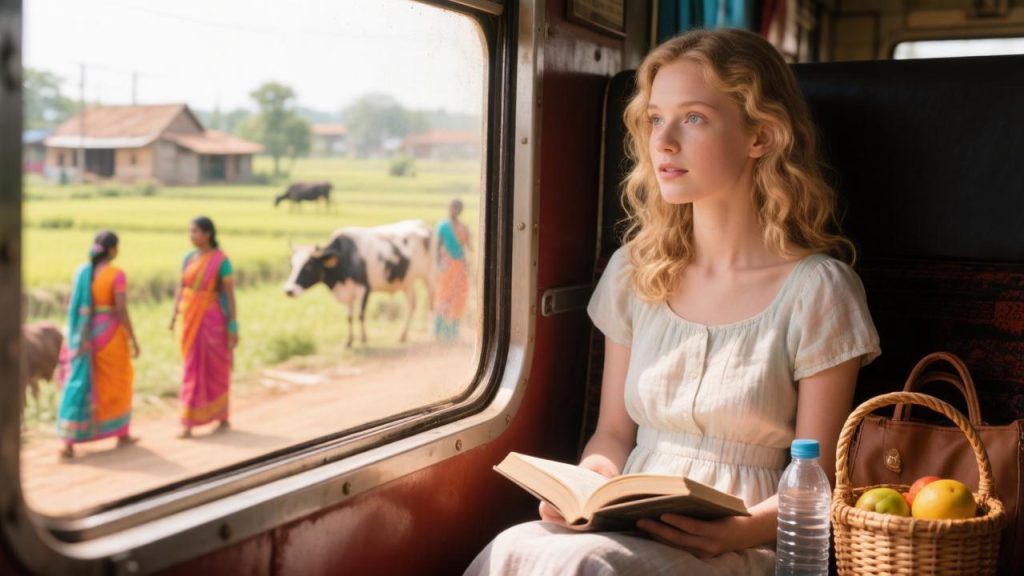
The hubbub intensified. The carriage, resembling a buzzing beehive, increasingly enclosed the space, leaving it completely empty for a full-fledged human life.
Nadia looked reproachfully at her athlete, who, as if nothing had happened, had spread his immaculate set of muscles on a hard, dubious-colored upper shelf and was sleeping peacefully.
The train stopped. A Hindu couple with numerous children, who were crawling on their knees and stepping on Nadya’s sandals, finally came out. And with a sigh, she looked once more at Konstantin sleeping peacefully, and with relief stretched out her legs on her bottom shelf. Which, according to the ticket, was registered to her, but was not used by anyone throughout the day. There were some heavy, sweaty women and men, frail old men and disgruntled old women, noisy and shameless young people, and even some strange, worn-out-looking foreigners with crumpled strands of hair.
No, it won’t happen this time, no one will dare to disturb her peace. She had just eaten overcooked vegetables with spices and was terribly sleepy. Putting her jacket under her, she closed her heavy eyelids and decided not to give up her legal positions in any case.
Vendors of all sorts of relatively edible substances ran along the platform, furiously and pleadingly shouting their names, which were indescribable in Russian. Women who looked like our Russian gypsies walked in flocks along the carriage and showed their infants, demanding their hands. For some reason, men dressed in women’s clothes were clapping their hands in front of their noses and also asking for something. But Nadia stubbornly closed her eyes and pretended to be asleep.
After a few minutes that seemed like an eternity, the train started moving. “Thank God, no one sat on the bottom shelf with her, and now she will be able to drive all the way to Varanasi, stretching her stiff, tired back on a soft sunbed covered with blue dermatin and worn on the sides from long use,” the girl thought only so and, almost without fear, opened her eyes… On the opposite bottom shelf, which was densely occupied by the new Hindu couple, a small grandfather in orange robes sat modestly perched on the very edge and calmly looked somewhere inside his own soul.
Nadia didn’t know if they were called sadhus, swamijis, or just sannyasins, but that wasn’t the point. Nadia had already seen quite a lot of men dressed in orange, red and even black robes, even during the few days they had already spent in India, but this one was extraordinary. He was extraordinary, and she didn’t know why. She stared at his calm features, at his typically beautiful Indian eyes, shining with some kind of barely noticeable light, at his hands humbly folded in his lap, at the patch of sindura on his forehead. She shamelessly looked at him so small, warm and surprisingly close that she even wanted to call him grandpa and climb into his lap like a little girl, rummage through his sparse gray beard, hug his neck and freeze, listening to his affectionate whispers.
Nadia shook her head, and the old man looked at her and smiled. And then, as if someone had pulled her by the scruff of the neck, She jumped up from her seat and immediately invited him to sit next to her. And he smiled once more, picked up his greasy bag, and timidly moved to her shelf, like a small child, tucking his legs under him. And then the girl was surprised to feel how cozy and good her soul felt, and for some reason her stiff back immediately stopped hurting, and she didn’t want to sleep, and instead of trash cans, clean green fields appeared outside the window, flooded with the rays of the midday sun. And everything became amazingly beautiful.
And so they rode, sometimes casually glancing at each other and smiling cheerfully.
But at the next station, a noisy couple with two children came in, whose well-groomed appearance, rich clothes and surprisingly white skin could tell that they belonged to a high caste, but by some strange chance they ended up in this carriage belonging to a low class. The father of the family, holding a doll-like little girl in his arms, looked at the grandfather in surprise and said something to him in Hindi. He showed them the tickets that corresponded to the upper shelves above this one, and according to which, again, they had the right to sit on Nadia’s lower one all day without a twinge of conscience. Grandpa, a little embarrassed, got up from his seat, briefly looked back at Nadia and disappeared.
An annoying tension hung in the carriage. But the noisy couple with the kids, not particularly embarrassed, joyfully and quickly settled down next to Nadia, as always, without asking, and without embarrassment at all, they filled the entire nearby space with their numerous bags, string bags and nets.
They talked loudly for a long time, laughing, joking with each other. Nadia was stuffy, she was so tired of the noise and the hustle of the road. Getting up and taking her bag with her documents, she barely stepped over all their luggage and headed for the vestibule.
The invigorating air hit the nostrils, the exit door was open at full speed of the train, and an orange grandfather was squatting next to this door, folding a small purse in his hands, modestly sitting.
This only happens in India. In Russia, you can’t squat down next to the open door of a train flying at full speed and look far into the fields scorched by the sun, look and greedily swallow this warm, and at the same time incomprehensible with some kind of cloying sweetness, Indian air.
And she, too, squatted down opposite and leaned her back against the dirty walls of the vestibule. The girl was mesmerized by these fields, and some strange feeling began to take over her mind. It was as if it had already happened, and it was incredibly accurate, so accurate that even this wind and smell were certainly very familiar. She looked at her grandfather and he smiled at her again. Once again, she was confused. Not all the people she had to face in her life had such a smile, this smile was special, this smile meant much more than benevolence and joyful feeling.
Her head was spinning, her eyelids were getting heavy, but inside her soul it was light and joyful.
Yes, it definitely happened before: that train, the orange grandfather with the aura on his forehead, and her, but for some reason she… was a boy.
3.
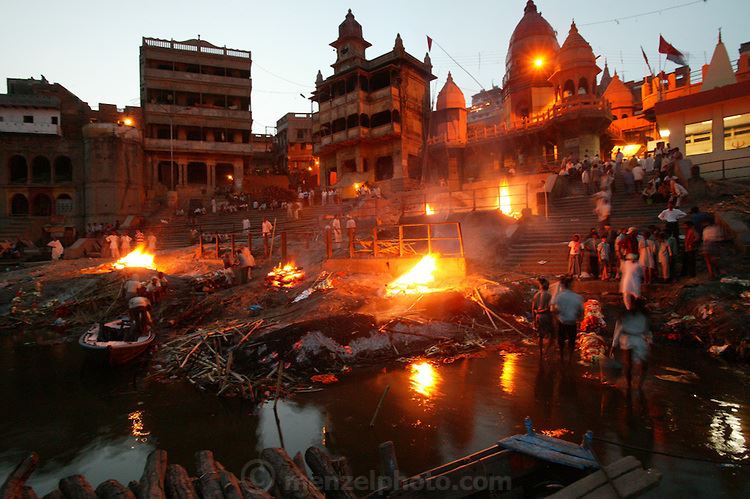
A small, well-kept house with pots of flowers and a shaggy palm tree that was always peeking out the window. A sun-drenched terrace and a young Indian woman with a cheerful Indian moustache, they loved each other and died together. He and she, Niraja’s father and mother. The new car that was supposed to bring them back from their relatives’ wedding didn’t bring them back. A large truck at full speed turned him into a shapeless mess very close to their hometown, and Neeraj was left alone, without his mother’s warm hands and without his father’s kind support. And now, sitting on the banks of the Ganges, the boy looked in fascination at their silent bodies lying next to each other, solemnly covered with sparkling gold brocade and edged with a red ribbon. It seemed that even through this cloth he could see their painfully familiar faces, in their strange calmness and nobility, staring at the sky.
“Don’t worry, son,” his aunt said, and patted him on the top of the head again. I wish she hadn’t done that. The touch of her hands on the top of his head caused an unpleasant vibration in him, as if someone was trying to break the invisible antennas on his head, through which he communicated with the space around him. She did this very often when she was around, and sometimes she pinched her cheeks painfully.
But it didn’t matter now.
Ghats, stone step baths for ritual ablution, as always, were dotted with half-naked pilgrims who hoped to wash away their sins in the majestic, already muddy Ganges. The sounds of unfamiliar music floated over the water, and in the distance the voices of believers could be heard singing prayers and hymns from the Vedas.
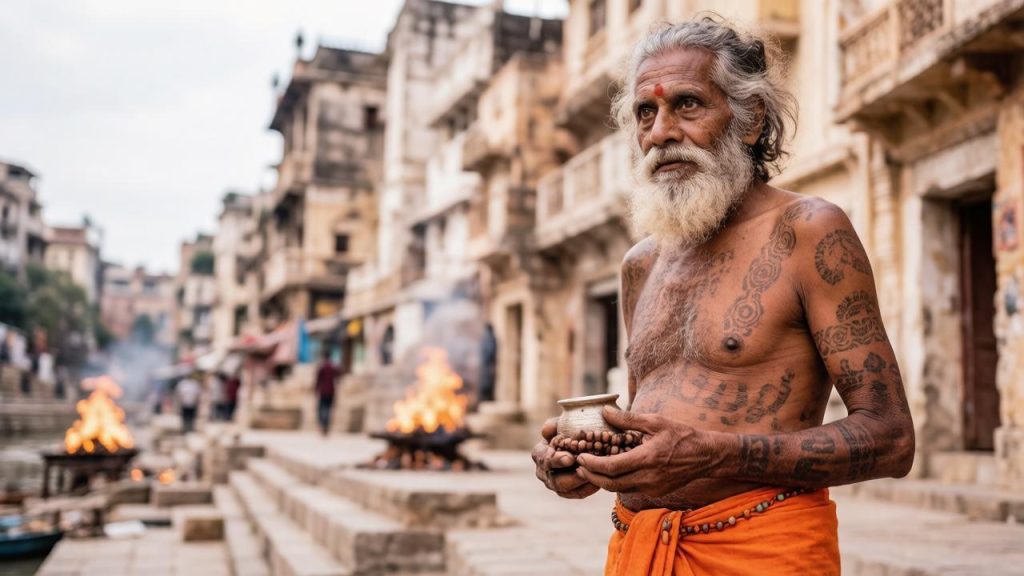
The sun was already starting to get hot when a sadhu priest in orange robes, with a large bump on his forehead, came and began to perform the funeral rite.
A bonfire made of a strictly defined number of logs lit up, and the gentle orange flame embraced two loving people, thereby making it clear to Niraj that his parents were irretrievably gone, leaving him alone in this strange and amazing world without their human warmth, care and, most importantly, love.
The flames were fanned by the wind, and blood dripped onto the burning logs. Soon the outlines of the bodies disappeared, merged into a single hissing plasma and dissolved into nothing, and before Niraj’s eyes, his dearest people in the world began to turn into ashes.
The bonfire was still burning down, but the priests, having rummaged through its entrails, took out the once-former human remains and ashes, and carefully lowered them into the waters of the Ganges, as always calmly floating.
Neeraj dipped his hands into the water, stroked its cool surface, and frequent drops poured from his eyes. But someone’s arm wrapped around his shoulders, and a soft, soft voice said:
“Don’t cry. Your parents are going to Nirvana. Because it is in this place that the way to a better world is open. This is one of the main paths in the whole of India, from where a person can pass after death into the world of eternal life and bliss.
But the boy was already crying, and his whole small body, trembling with sobs, was pressed against the chest of this completely unfamiliar sadhu, who daily transports souls to the other shore of dubious reality.
Funeral processions were coming down the hill. Again, new corpses were being carried to the Manikarnik, in Benares, in order to die normally, you had to stand in line.
Uncle Sahil touched Niraja on the shoulder and told him to follow them. A small group of the boy’s relatives walked slowly through the ghats, then climbed a little higher, went into a narrow alley between old houses washed by years of monsoon and went out onto the main street, heavily crowded with carts, cars, and auto rickshaws always scurrying and pestering passersby. Here, the world of the dead blended seamlessly with the world of the living. The screams of street vendors, sellers of milk and cottage cheese could be heard. Along the road, bracelets with protective mantras carved on them were sold on open tables, glistening in the hot sun, statuettes of Indian deities, clay bowls for burning incense, all kinds of ritual products used in funeral rites, and copper vessels with Ganges water poured into the mouth of the dying. And immediately, as if talking about the continuation of life, saris, embroidered with silver and gold, bright colorful capes and shiny women’s jewelry were hung in open shops. Colorful children’s clothes were scattered on the tables, and elegant men’s suits were embroidered with fancy patterns on the mannequins.
The relatives began to say goodbye. Niraj had to take the train back to their small town, which was located near Benares, along with Aunt Doram, his father’s sister, Uncle Sahil and their children. And the rest of the relatives left in their cars and in other directions.
Aunt Doram was born with a defect, her legs were of different sizes, she limped noticeably, and no one wanted to marry her for a long time. But it was necessary to get married in India, otherwise people would be stigmatized, so even though their family was a higher caste, her father’s parents, grandparents, collected a large dowry for her and gave her to Uncle Sahil, a merchant who was always thinking about money. It was said about him that he associated a person only with a wallet, and the qualities of a person with the ability to empty this wallet.
“And where are we going to put him?” he grumbled on the way, not letting go of his six-year-old daughter and four-year-old son. Aunt Doram walked behind, carrying a carefully beaded bag and her newly pregnant belly.
- He’ll live in the store, he needs an assistant there anyway, we’ll fire Shate, but let him work there, everything will be useful, and there’s no one to drive away the rats at night, how many goods these creatures have ruined, and Rajmah and dal have gnawed. Don’t worry, we’ll figure something out. Extra hands will never hurt in the household.
Neeraj cringed at these words, he was afraid to spend the night alone in his uncle’s dark and scary store, infested with rats and spiders. He is used to living in bright, spacious rooms with a white marble bathroom in his family home. But for some reason, no one said that he should stay there.
- Auntie, what about our house where I lived with Mom and Dad? – the boy stammered timidly.
- And the house will have to be sold to Niraj, or at least rented out, because now you will need money to feed and clothe you.
But the thought made the boy’s legs give out.
So he has nothing left, not even his little room filled with soft fluffy toys and an almost real railroad that his dad just recently bought him, and even a palm tree that constantly looked in his window….
Something shrank and ached terribly in his small chest, and he didn’t say another word all the way to the train station, where they still had several hours to wait for the train.
Cows walked around the square, which was located under a huge roof next to the railway ticket offices, and people slept on the floor with paper and their capes spread out. Niraj carefully lifted his legs and walked between these rows of people, to the accompaniment of constant announcements about approaching trains, and, envying their slumbering serenity, he thought about how to continue living with his life and what he should do in it now.
The train arrived at sunset. And immediately, so recently, the serenely resting part of humanity turned into a buzzing hive. People got up, hastily packed their belongings and rushed to the carriages, constantly shouting and asking each other, and answering each other.
Neeraj and his relatives were almost the last to enter, as they had been floundering in the raging stream for a long time and could not enter together. But when they finally succeeded, and the train started moving, the boy carefully squeezed through to the open vestibule door and leaned against the wall, squatted down.
The train blew its horn and took them all together into an incomprehensible and unknown tomorrow. The unsightly houses of local residents floated past, then the city’s garbage dumps and the slums of the poor, and now the fields were almost in sight, as the train noticeably slowed down. It was a small suburban station, where people were also crowded and sleeping, and a car was parked on the platform, piled high with mailboxes.
The boy stared with unseeing eyes at the rapidly darkening sky, then turned his gaze down and suddenly, among the crowd, over the scurrying heads, he saw a familiar face with a large bump on his forehead. The sadhu saw him too and smiled at him with his kind and surprisingly affectionate smile. Niraj hesitantly raised his hand and waved to him, the Sadhu waved back and, turning around, slowly walked along the road, which was located behind the barrier and lost its outlines in small suburban buildings.
In Niraja’s small chest, something fluttered violently, hammered in his ribs, there was something familiar and familiar in this sadhu’s smile, just as his father and mother smiled at him recently when they said goodbye and got into a new car, and he did not want and could not remain without this smile forever.
The train began to pick up speed.
The boy looked into the carriage, where Aunt Doram was already dozing in the first seats, at his uncle, who was sitting tenderly hugging his buxom children, and bowing to his tired and indifferent face, turned to the open vestibule door and jumped off the train.
4.
“Baba,” he shouted in a hoarse voice, smearing streams of water mixed with roadside dust on his cheeks, and his small feet carried his little body into a strange and incomprehensible future.
So he ran for a long time, until his legs became wobbly and unruly, and there was absolutely nothing left to breathe, because his lungs did not want to breathe. But the streets were endless. He stopped and gasped for air, trying to figure out which way the Ganges should be.
But he couldn’t figure it out. The crooked streets constantly curved and offered him a diverse choice of directions. The boy stood at a loss at an unfamiliar entrance, and did not know what to do next. It was already dark, and there were fewer people on the streets. Rickshaws were still scurrying back and forth, decent citizens were still leisurely marching along with their wives decked out and hung with gold, shops were already closing one by one. But it seemed that Niraj had become completely invisible, no one was paying attention to him, and when he wanted to address someone, they looked at him in surprise and passed by. Inadvertently looking into the mirror of a belated street barber, he discovered that he was covered in dust, and the smeared tears on his cheeks made his face look like an incredible street beggar.
But there was nothing to do. He realized that he no longer knew where to go. He did not know this city, he could not determine in which direction the place where the dead were burned was located, and the only solution that came to his mind was to climb onto the roof of the tallest house and see which way the Ganges was located.
After waiting at the threshold of a cheap, dirty hotel for the attendant to leave, he nimbly shot up the narrow staircase to the top. The roof was spacious, and still warm from the heat of the sun. Niraj stared into the darkness for a long time, but he did not see Ganga. In utter despair, he sat down on the scraps of an old mat, wearily lowered his head on his hands and closed his eyes for a minute. He did not remember how his thoughts drifted away and fell silent somewhere, how heavy eyelids hid him from the incomprehensible reality and unresolved problems.
The boy slept with his cheek propped on a small fist like a child, curled up against the night dampness and only occasionally sobbing casually.
In the middle of the night, he was awakened by a rude male scream, and someone’s hard hand mercilessly dug into his fragile shoulder.
“This is the thief, the thief,” this voice shouted and dragged him somewhere into the blurred room. When his eyes focused, and Niraj finally realized what had happened, he abruptly yanked his hand out of the man’s hands, but the man squeezed his wrist even harder.
He was locked in a small, musty-smelling storage room. There was no light, and clouds of mosquitoes were flying out of the latticed window. The damp floor was covered with something sticky, and two lizards were sitting on the wall in the moonlit space, talking loudly all the time.
It wasn’t supposed to be like this. This shouldn’t have happened. Some kind of childish indignation tore at his soul. Neeraj went to the window and looked out. There was almost no lighting, only somewhere in the distance, belated rickshaws sat under a small lantern and chewed betel.
“Help me,” the boy whispered timidly, but he knew that no one would hear him that way, but he couldn’t stay here in this terrible place. He took a deep breath and shouted out the window.:
“Help me!” Help!
He screamed long enough until his voice was hoarse, and only he paused briefly to catch his breath when he heard footsteps in the hallway, and soon a streak of light broke through the open door and blinded him.
- What is this!? A woman’s voice hissed menacingly.
“I’m Neeraj.”
“So what?” Why are you shouting? You’ll wake up the whole hotel.
“I have to go to the Ganges.”
- So what, you never know where you need to go. How did you get here?
“I wanted to go to the Ganges, to the Manikarnika, where the dead are burned,” the boy replied timidly, “But I got lost and climbed onto your roof to see which way the Ganges was, but a man grabbed me and put me in this room.
The heavy Indian woman grunted with displeasure and sat down on the only chair, pushing the candle flame to his face.
- Manikarnika? – She asked in surprise, – And why do you want to go to a Manikarnik?
- I want to see a sadhu who sends the dead to Nirvana.
“Why?”
But then suddenly the boy stopped talking. He hadn’t asked himself that question yet.
Then the woman sat for a while, lifted her heavy body heavily from the chair, and was about to leave. But Neeraj said resolutely:
“I’m going to scream!”
The woman turned around, stood for a moment thinking in the doorway, shook her head in displeasure and motioned for them to follow her.
They went down the same steep flight of stairs, where the sleepy attendant slowly opened the door to the street, and the Indian woman, calling out to one of the rickshaws, said:
- Vika, take the boy to the Manikarnik.
- Why is it so early? A voice rasped from the darkness.
- It’s better to be early, otherwise Amid will wake up later and there will be more conversations. They’ve started a game, they’ve caught a thief…” she grumbled, giving Niraj a little push and leaving him alone on the street, she went into the house.
- Well, let’s go? – said a young boy, coming up, pulling up his pants and straightening his once white shirt.
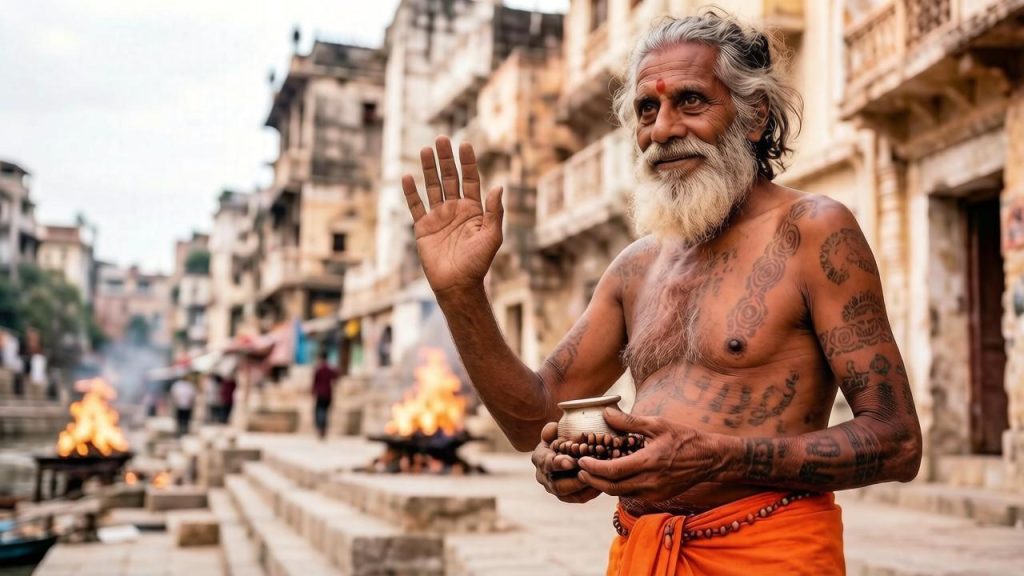
At dawn, when the young priests, brandishing incense burners, began to congratulate Ganga on a Good morning, chilled by the dampness of the water and the cold of the night, on the eternal ashes of the eternal city, on the banks of the sacred river, Niraj met his Teacher.
He looked into his eyes, and now he completely understood that this sadhu priest in orange robes was everything to him now: father and mother, and the wisdom of the whole World. And the elderly priest smiled kindly at him and also looked into his eyes.
From that day on, his ministry began. At first, like the “untouchable houses”, he counted and brought logs to the bonfires and poured the ashes onto the shore so that the ascetics could anoint their bodies with them. After a while, he could already sing prayers addressed to the gods. And a little later, he already knew why people live, and why when they die, they are born again.
- People don’t think about death. They live in this world desiring happiness, but receiving only small pleasures and sufferings, they do not know what real happiness is. And when they die, their souls become very confused, then they are guided only by fear and their evil deeds, what they did when they lived. No one can help them in the other world except us,” the sadhu said, lighting incense on the altar, “Because, with the knowledge of ancient wisdom, we can show them the way in that world, pray for them and ask the Gods to bless them, absolve them of their sins.
- And it helps them?”What is it?” the boy asked, handing him a garland of flowers for offerings.
- of course. Prayers and instructions not only calm souls and protect them from terrible suffering at the time of death, but it also happens that if a soul is pure and noble, then having received such instructions at the time of death, it can free itself from the cycle of rebirth, where it has to suffer and find true happiness in the world of bliss.
And despite the fact that Niraj had to live in the cold walls of an old temple, and there was no trace of the comfort of the past, he understood how important it was what he did and what he devoted his life to.
So they lived, day after day, seeing off the souls of the dead, reading the Vedas and praising the Gods.
They often had to travel by train to other villages when the dead could not be brought to the Ganges for some reason, but the relatives of the deceased wanted none other than this sadhu to help them. Because people trusted him, and the news of his power and wisdom spread far beyond the borders of Koshy.
Until the death of his Teacher, Neeraj did everything in his power to ensure that his smile never left his face. And when the Teacher died, lowering his unburnt body into the Ganges, the honor of which was awarded only to priests, babies and people bitten by a cobra, he swore that he would never forget his kindness, and would pray to meet him again in the next life.
The next day, instead of the Teacher, he performed funeral rites, escorting the souls of the dead to the other shore, and this continued until death took him away.
5.
“Om namo Narayana, Niraj,” the orange grandfather said softly, “he said it so softly that it seemed as if these words could easily have been drowned out by the sound of the wind and the clatter of wheels, but she understood them. Nadia looked into his eyes and began to cry.
- Om namo, Narayana, Babaji.
Through her tears, she saw that smile radiating, the kind of smile that only those who can truly love can have, without dividing anyone into castes or creeds. She was crying and laughing at the same time. Affectionate native arms hugged her shoulders and, finally, she understood why Konstantin brought her here, why it was so necessary for her to be in this distant, dirty, but painfully native country.
/ Elena Kshanti/