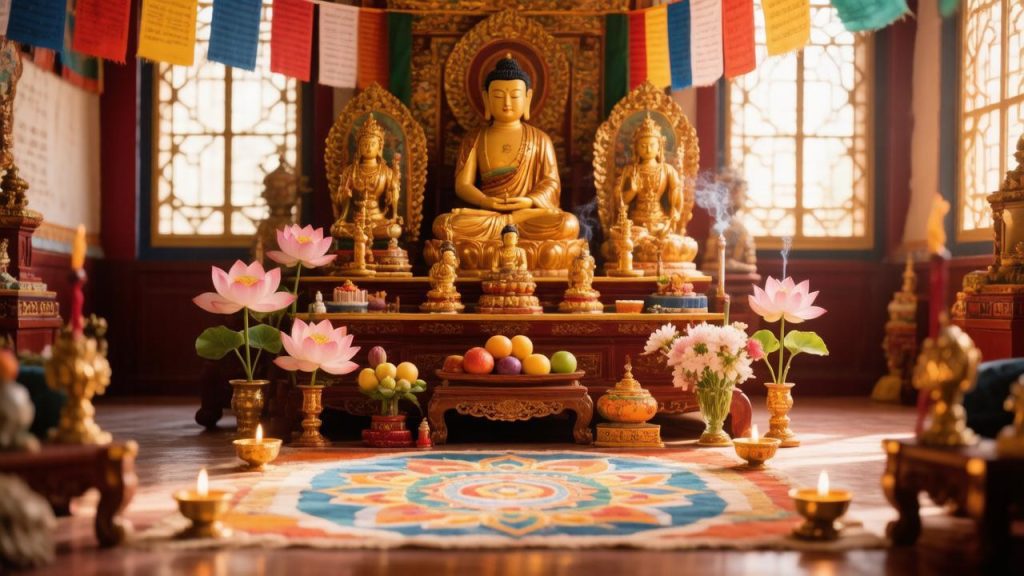

Some of the guys have already taken up retreats in earnest and are undergoing preliminary Buddhist practices called Nendra. For such purposes, and further, if a person decides to lead a spiritual life, an altar is needed. Firstly, it gives a blessing to the place where you live, secondly, it helps you focus on higher objects, and thirdly, accumulate merits by caring for the altar and making offerings.
The famous Buddhist writer Alexei Tenchoi spoke in great detail about how to arrange an altar.:
“The altar should be above the waist. It is also important to remember that the images on the altar – statues of Buddha, Lama Tsongkhapa – are not just material objects and not simple images, but that they represent a truly living Buddha, a living Lama Tsongkhapa. And if you treat statues, images of deities in this way, then whatever offering you make, it will become a very powerful offering and you will receive a blessing. Place an image of the Buddha on the right side as a symbol of the Buddha’s Body, and place texts and scriptures on the left side as a symbol of the Buddha’s Speech.
If you have a stupa, it is very good to keep it on the altar as a symbol of the Buddha’s Mind. When you see images of Buddha and Lama Tsongkhapa on the altar, you should treat them as the real Buddha and the real Lama Tsongkhapa, as the embodiment of all your Spiritual Mentors, and you should feel that they are next to you in the room. Therefore, whenever you have any negative thoughts, you should immediately remember that Buddha and Lama Tsongkhapa, the embodiment of all your Teachers, are on the altar in your house, and you should immediately stop yourself, stop all negative thoughts, and tell yourself:
“It’s a shame to think like this in the presence of Buddha, Lama Tsongkhapa, and Spiritual Mentors!” And with this method, you will gradually be able to improve your mind and receive blessings.
You can also put images of various deities on the altar – Tara, Manjushri, Yamantaka, and you should know these deities. You should also know that in the Gelug tradition, there are three main defenders of Dharma: the defender of Dharma at the beginner level is Kalarupa, which is the wrathful aspect of Manjushri; the defender of Dharma for the intermediate level of practice is Namsei or Vaishravana, the defender of Dharma for the advanced level is Mahakala.
So, when you equip the altar, in the center there should be a statue or an image of Shakyamuni Buddha, the main holder of all the Teachings of the Buddha, an image of Lama Tsongkhapa, the embodiment of all your Teachers, as well as an image, a portrait of His Holiness the Dalai Lama. There may also be images of various deities here, but it must be remembered that the images of the defenders of the Dharma are not in the center of the altar, but on the side.
As for the symbol of the Buddha’s Speech, if you have the text “Prajnaparamita sanchaya gatha” or “Dodudba” in Tibetan, that’s very good, but the most important thing is that you have the Lamrim Chenmo text on your altar.
We have to make offerings to the Three Jewels.: Buddha, Dharma and Sangha, and put them on the altar. Offerings can be in the form of flowers, food, incense, fruits, but the prerequisite is that everything we offer must be clean.
After we have made offerings to the deities, we need to bless these offerings by saying: OM AH HUNG (3 times).
When we say HUNG, this cleanses the impurities of color, taste and smell.When we say, “Ah, our offerings turn into nectar (for example, water, tea, drinks or an apple turn into nectar), this nectar is divine, very beautiful and delicious.
When we say OM, our offerings increase innumerably. For example, although we offered one cup of tea, after pronouncing these three syllables, we have to imagine that our offerings have increased hundreds, thousands, and so on times.
If you pour clean water into seven cups in the morning, it must be drained into a clean container in the evening, and then onto clean land where there are no roads or sewage (the road is considered a polluted place), for example, onto land where trees or flowers grow, but not indoor ones. You can not drink this water, you can wash or wipe a small child. If you bring tea in the morning, this is also considered a Buddhist tradition, and you need to drink it later. If you don’t want to drink it, you can also pour it into a clean place.
The most important thing is our motivation, the motivation of the offering, the gift. Now about the effect of the offering — about how the water is poured into the cups. Traditionally, the water is not poured so that it is flush with the edge. When the water
When it is poured, it is left on top not topped up to the edge by the size of a barley grain.
And what’s more important: the water is poured every morning. Fresh water is poured in the morning and poured out in the evening. Then, in addition to the cups of water, if you look at the various instructions, starting with those that the Buddha himself did in his Sayings, and then the texts that were based on these Sayings, they talk about what else is needed in the altar. A lamp is needed. Now, in our time, when there is electricity, it is possible to make an electric lamp. The fact that we light a lamp is connected with clarification, because the lamp clarifies the darkness. This action refers to stimulating the development of wisdom. Wisdom, as we say, is both the deepest wisdom and also the overcoming of our ignorance of something — that is, the whole sphere of knowledge. By lighting a lamp and keeping the light on, we strive to clarify our knowledge.
It doesn’t matter what you bring. Whatever you want to bring, bring it. After all, here the virtue that you produce depends entirely on yourself, on your specific case, on your inner desire and aspiration — and on nothing else.
Every day, as soon as you get up in the morning, make three bows in front of the altar. You make three bows and think to yourself like this: “I will try to do only good things.” This is how you tune into kind, good behavior, and a noble lifestyle. And you can offer up a prayer to the Three Precious Ones so that you can spend your day in this way. In the evening, when the day ends, you again make three bows in front of the altar. And before going to bed, we think about how our lives are going — what we are doing, what was good, what was bad.
If we have done something good, we rejoice for ourselves and strengthen our resolve to continue this, to further develop our good qualities. And the fact that we have done something wrong, whether at the level of the body, or speech, or in our thoughts, we regret, deeply regret this and decide to try to refrain from it with all our might in the future.
This is what Buddhism consists of, in fact, in the gradual transformation of oneself, in purification and development, and this is our spiritual practice. And if we really turn to the Refuge of the Three Precious Ones, then we are transformed, we become better — and this is noticed by ourselves and others. And that is how you will come to the point that one day you will achieve Awakening yourself, and then you will embody this refuge in yourself — you will be your own Refuge. And you will be a Refuge for others.
If you live in a multi-room house, it is best to make an altar in a separate room. It is not recommended to put an altar in the bedroom, it is forbidden to have sex next to the altar – this is adultery in front of the Buddhas and deities. If you have one room, you need to cover the altar with some kind of cloth.
In short, what is needed?
- stand
- a statue or photograph of the Dalai Lama
- seven cups
- the lamp.
And also: - water,
- rice,
- a flower,
- incense,
- fruit or biscuits,
- a small musical instrument or shell,
We need a set of cups of the same type, matching the size of the altar and, usually, small ones. The more valuable, beautiful and noble the material they are made of, the better our offering.The golden rule is that everything should be beautiful, noble and pure.After washing, prepare your offerings on the altar in front of the image of the saints and say “Dharani clouds of offerings”:
NAMO RATNA TRAYA-I, NAMO BHAGAVATE BEDZR SARAH PRA-MARTANE,
TATHAGATAYA, ARHAT SAMYAKSAM BUDDHAYA, TADYATA,
OM BEDZRE BEDZRE, MAHA BEDZRE, MAHA TEDZA BEDZRE,
MAHA BIDYA BEDZRE, MAHA BODHICHITTA BEDZRE, MAHA BODHI
MANDOPASANG KRAMANA BEDZRE, SARVA KARMA AVARANA
BISCHODHANA BEDZRE SUOHA.
The sutras say that by reciting this dharani, a shower of offerings is poured in front of the Buddhas and Bodhisattvas.
The first and second cups are Water for drinking and for ablutions.
In practice, it turns out that the same water is used to fill the first two cups, although it is intended for different purposes: transparent, clean and drinking water. Put a few saffron petals in the water.
The third cup is Flowers. Fill it with rice and place a flower on top.
The fourth cup is Incense. These are several sticks stuck in rice. Tibetan, Indian, Mongolian, incense – according to your taste.
Attention! The incense stuck in the rice is not intended for burning.
In fact, the incense burned is placed in another container, for example, an ordinary cup filled with rice or sand, which is placed in front of the altar.
Next comes the lamp – Light. A disposable paraffin candle is suitable for the offering.
The fifth cup is Scented water. The water is the same as in the first two cups.
The sixth cup is Food.
The cup is filled with rice, on which a beautiful fruit, cookies, etc. are placed. You can also put a small “torma” made of flour in the cup, which is called “shelze” – it symbolizes the offering of food.
The seventh cup is Music. We put a symbol of a musical instrument in a cup filled with rice, most often a shell (symbolizing a shell) or a bell. The seven cups should be carefully aligned and placed at a distance of a grain of rice from each other; it is said that too much distance between the cups predicts distance from the Teacher. The lamp is placed either in front of the statue (with cups), or between the fourth and fifth cups.”