

Vedanta is considered the origin of both Hinduism and Buddhism, and even according to unproven data, Christianity (assuming that Christ studied in India), therefore, it seems to me that this information will be of interest to all spiritual practitioners.:
Bhagavad-gita (10:25): “Of the great sages, I am Bhrigu, and among the sounds, I am the sacred sound Om. Of the sacrifices, I am the repetition of the holy names (japa), and of the immobile, the Himalayan Mountains.” Japa is the most important sacrifice, the most important yajna.
The word “japa” consists of two words: “ja” — birth, “pa” – protection, maintenance, that which protects and preserves the whole creation. As applied to us, japa is what creates our spiritual personality and protects it.
As long as we repeat japa, we will be safe. This is the best protection you can have!
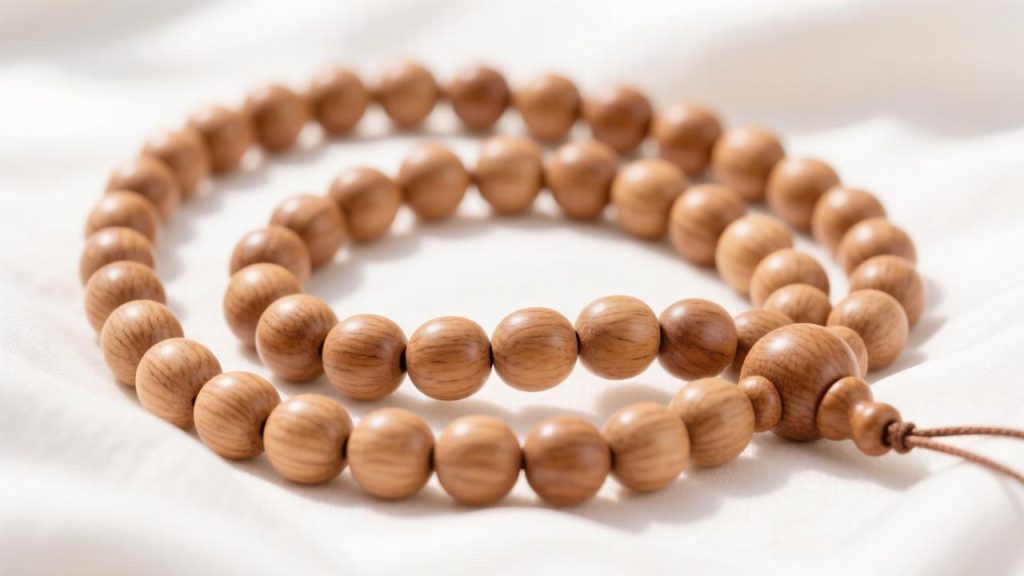
The instrument of japa is the mala rosary. There is a prayer addressed to the rosary in the sastras.:
“O mala, the embodiment of maha-maya, the personification of all the forces of the universe,
All four goals of human life are hidden in you.
Be the source of all perfection for me.,
Help me overcome all kinds of obstacles.
When I take you in my right hand during japa,
Graciously grant me all kinds of perfections.”
Physically, the rosary consists of a thread on which 108 beads are strung, as well as another bead, the 109th. All the beads are separated from each other by nodules.
In the Bhagavad Gita (7:7), Krishna says, “O conqueror of wealth, there is no truth higher than Me, everything rests on Me like pearls strung on a string.” By analogy, rosaries with beads strung on a string symbolize the created world. The sutra is a symbol of the primordial, subtle, unmanifested energy emanating from Krishna and being the basis of the entire universe. The beads symbolize the manifested, visible matter, represented in the form of an infinite variety of worlds, and the number of beads, equal to 108, symbolizes infinity.
The number 108 has many symbolic meanings, one of which, astrologically, reflects the universe — it is 9 planets in 12 constellations or 27 nakshatras in 4 padas or parts. The nodules between the beads are a symbol of the primordial, unmanifested matter (prakriti). The main rosary, the 109th bead, symbolizes Mount Meru, the invisible, thin axis around which the universe revolves, and also symbolizes Krishna.
Another name for the rosary is aksha mala. Aksha is the eye. With this eye, one tries to see Krishna, to find him in the infinite variety of worlds.In fact, the rosary is a symbol of the created world, which should teach us, when looking at this world, to feel the gaze of the Lord everywhere, His presence and His will.
When reading japa, you need to start from the central bead and lead the rosary clockwise towards yourself. When you reach the central bead, you need to turn the rosary over and guide it again, in a different direction. In this case, you can not cross the 109th bead. If someone jumps over the central bead, then he does not get any result from repeating the mantra. The circle, as a symbol, represents the wheel of samsara, and to avoid this circle, it must be broken, which we do when we reach the 109th bead and turn in the opposite direction.
Prohibitions that must be observed when reading japa:
- it is forbidden to recite the mantra while counting the rosary with your left hand (it is unclean);
- do not touch the rosary with your left hand;
- it is forbidden to recite the mantra with the right hand if it is defiled (the hand must be clean);
- do not touch the rosary with your index finger;
Do not touch the floor or other unclean places with rosaries., - it is forbidden to shake and wave the bag when reciting the mantra.;
- You cannot recite a mantra with your head covered.; (it’s not an understandable moment, most likely for prabhu)
- you can not recite the mantra lying down, yawning, talking to someone, walking;
- You can’t recite the mantra naked.
Symbolic meanings of the fingers of the right hand:
The thumb is Bhagavan, Krishna;
The middle finger is Jiva or the mind and heart of man;
The index finger is a false ego (ahankara).
When reciting a mantra using the thumb and middle finger, the sound of the holy name enters a person’s heart and consciousness.
The mantra can be recited using other fingers to achieve the following results:
The thumb and index finger are for revenge (the mode of ignorance);
■ thumb and ring finger — to eliminate troubles;
■ thumb and little finger — to fulfill all desires;
Therefore, the mantra should be repeated on the middle finger, because it is connected with the heart.
The mantra can be recited on a rosary with beads made of various materials to achieve the following results:
- rudraksha beads — for fulfilling all (both good and bad) desires;
- Lotus seed beads — for defeating enemies;
- gold beads — for obtaining all material pleasures;
- crystal beads — for good luck;
- Tulasi beads are for fulfilling only those desires that will benefit you.
The sastras recommend that reasonable people recite the mantra by moving the tulasi beads with their thumb and middle finger.
One should keep the following secret (recommended by Hari Bhakti vilasa)::
- The deity he worships;• the name of your spiritual teacher;
- a mantra received from a spiritual teacher;
his japa mala (rosary).
We should not show our beads, because it is something intimate that is between us and God. If we do not read japa, we should put them in a clean, hidden place, after bowing to them, they should not be lying around. The rosary should be in a bag called gomukha, which means “cow’s mouth” or “divine speech.”
After all, why do we need all this knowledge? We should have a clear understanding that everything is connected in this world. When we are in the mode of passion, we divide the world, divide it up, and enjoy what is highlighted. In the mode of goodness, we try to understand the unified nature, the connection of all things, we try to understand how different objects of this world are interconnected.
In order for a person to gain the wealth of japa, all the benefits of chanting a mantra, he must:
✓Focus your mind, put it together, the mind must be pure;
✓be silent during the repetition, do not talk to anyone;
✓think about the meaning of the mantra or at least remember who we are calling, who is Krishna, Rama and Hare;
Do it with patience and affection, without worry, and then it will give you the whole treasure of repetition.
It is also recommended:
✓Chant japa in a room where distracting objects unrelated to Krishna are not in sight (an altar room is ideal);
✓try to sit (stand, walk) – with a straight back;
✓Repeat japa in a ventilated area;
✓Place an image of Krishna or a spiritual master in front of you;
✓Chant japa next to other devotees (if the general background of japa is not too loud and you can hear your mantra clearly);
✓Repeat japa in front of Tulasi maharani.
✓Repeat japa in a secluded place in nature.
“This article is based on a lecture by Bhakti Vigyan Goswami”